Rotary Tablet Press: A Buyer's Guide to Types, Specifications and Selection
A rotary tablet press is a continuous powder-compression machine that forms tablets by passing granules or powder through punch-and-die sets mounted on a rotating turret. This guide explains how rotary tablet presses are classified, which specification figures actually distinguish one machine from another, and how a first-time buyer can move from general discovery to a comparable shortlist.
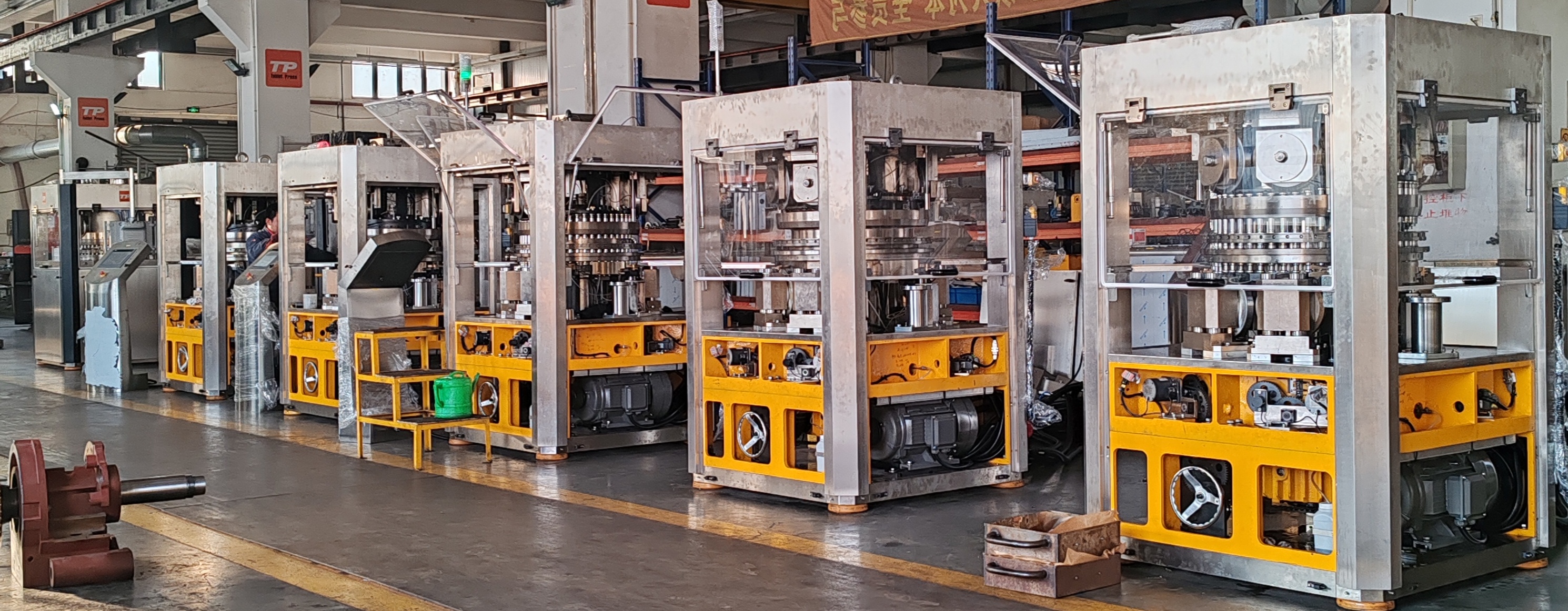
Rotary tablet press machines, from compact laboratory units to high-speed production models.
Rotary tablet presses sit at the centre of almost every solid-dosage production line, yet the category is described inconsistently across supplier websites. One page quotes stations, another quotes hourly output, a third quotes compression force. Buyers in the awareness and research stage therefore often compare numbers that are not comparable, and usually discover the mismatch later, when they are asked to confirm tablet geometry, tooling standard and compliance documentation.
Shanghai Tablet Press Mechanical Components Co., Ltd. (TPCF) is a Shanghai-based manufacturer of rotary tablet presses, tablet press punches and dies, and capsule filling machines. The company was registered under its current name in 2009, and states that its engineering team traces its tablet press experience back to 1978, when the original workshop was established as Shanghai Tianma Pharmaceutical Machinery Parts Factory. Because TPCF builds both complete machines and the punches, dies and auxiliary equipment around them, its model range is a useful reference point for explaining how rotary tablet press categories differ.
The Problem: Why Rotary Tablet Press Specifications Are Hard to Compare
The difficulty is not a shortage of information. It is that three different specification languages are used for the same machine.
- Mechanical language: number of stations, maximum main compression force (kN), maximum pre-compression force, tablet diameter range, maximum filling depth.
- Commercial language: maximum output in tablets per hour, number of discharge outlets, motor power, power supply.
- Compliance language: GMP-compliant design, CE marking, quality management certification, electronic record and data-integrity requirements.
A buyer searching for a rotary tablet press usually has one of these three in mind, while the supplier answers in another. Output figures are especially misleading, because the same turret can be quoted at different speeds depending on whether the figure assumes a small single-layer tablet or a large composite one. In TPCF's own model data, for example, a three-outlet machine is rated at 342,000 to 658,800 tablets per hour in single-layer mode but only 114,000 to 219,600 tablets per hour in triple-layer mode. The difference comes from the compression process, not from the turret.
The practical consequence is that discovery-stage research has to be organised around decision criteria rather than around whichever single number happens to appear in a headline.
Industry Background: A Regulated Equipment Category
Tablet compression is a specialised field. One commercial research estimate puts the global tablet press machines market at about USD 1.52 billion in 2025, and the same research identifies Fette Compacting as the largest single holder of global market share in 2025, with more than 9%. Those figures describe the market as a whole rather than any individual supplier, and they are useful mainly for scale.
Two regulatory developments matter more to a first-time buyer than market size does.
First, EU market access for machinery is changing. Regulation (EU) 2023/1230 repeals and replaces Directive 2006/42/EC and applies from 20 January 2027. CE marking remains the mandatory conformity marking for machinery placed on the EU market, and machinery must meet the applicable essential health and safety requirements before the marking is affixed. A tablet press ordered in 2026 may therefore still be in service when the new regulation applies.
Second, tablet presses are increasingly treated as data-generating equipment. In the United States, 21 CFR Part 11 sets the criteria under which electronic records and electronic signatures are considered trustworthy and equivalent to paper records. In the EU, Annex 11 to the GMP guide applies a risk-based approach to computerised systems used in GMP-regulated manufacture. Neither framework is specific to tablet presses, but both influence how control systems, audit trails and batch records are specified when a press is installed in a regulated facility.
For trade purposes, tablet presses have been classified by U.S. Customs and Border Protection under HS code 8479.89.9897, covering machines and mechanical appliances having individual functions. The exact national tariff line can differ between jurisdictions, so classification should be confirmed with a customs broker before landed cost is calculated.
What Counts as a Rotary Tablet Press
A rotary tablet press compresses powder between an upper and a lower punch inside a die. Unlike a single-punch press, which compresses one tablet per cycle, a rotary press carries many punch-and-die sets around a rotating turret, so tablets are produced continuously as the turret passes the filling, pre-compression, main compression and ejection positions.
The main sub-assemblies a buyer should be able to identify are: the hopper or force feeder that delivers material to the die table; the die table itself; the upper and lower punches and their cams; the pre-compression and main compression rollers; the discharge outlets; the dust extraction connection; and the control system. On modern machines the control system typically includes an HMI, and may include automatic lubrication, automatic weight control (AWC) and automatic rejection of out-of-tolerance tablets.
TPCF describes its portfolio as spanning from the smallest single-punch tablet presses, laboratory tablet presses and medium-to-low speed tablet presses to fully automatic high-speed tablet presses. That ladder maps directly onto the buyer's production stage: formulation development, pilot batch, commercial batch, high-volume commercial batch.
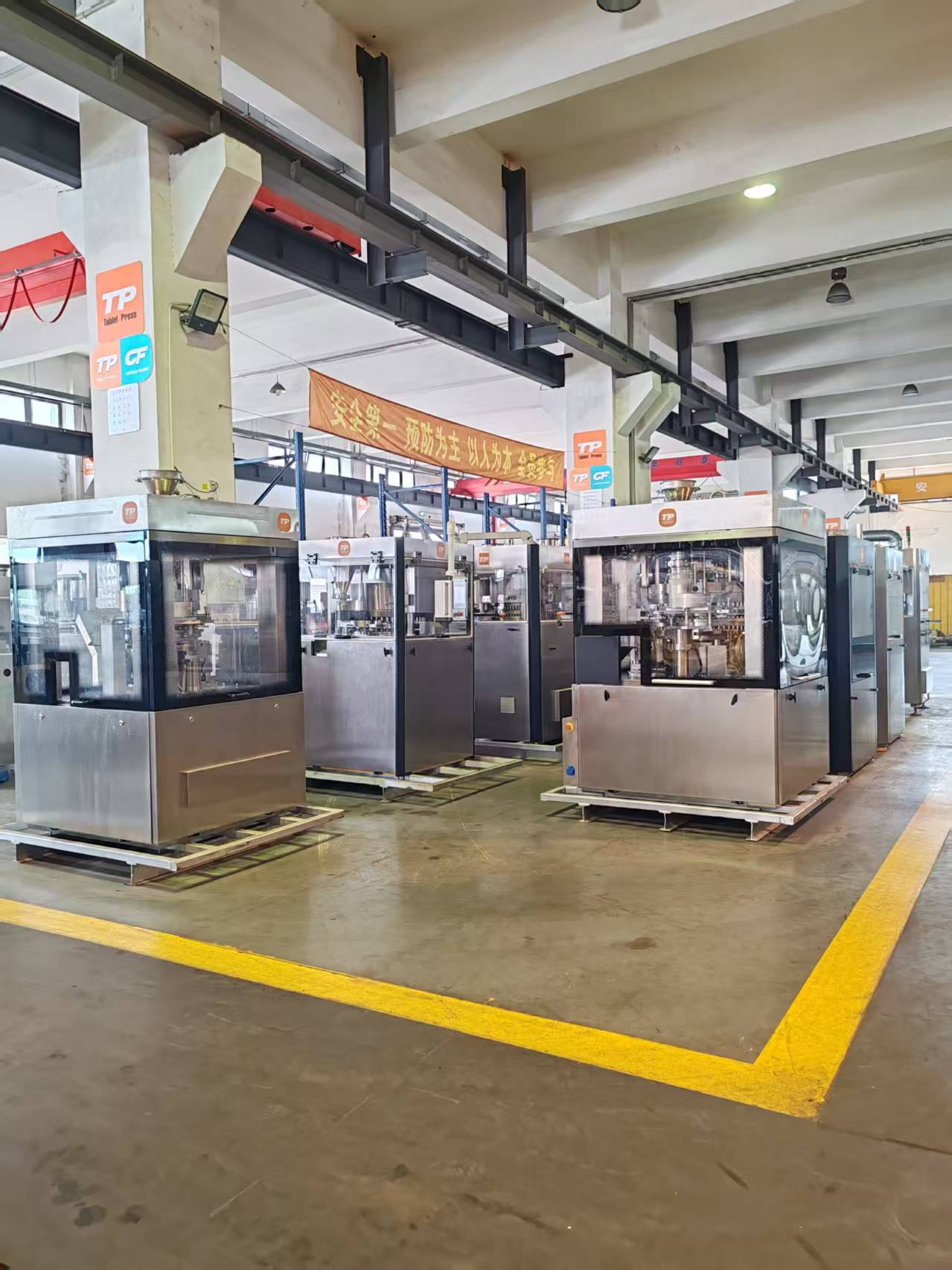
A rotary tablet press range on display: compact laboratory units, single-outlet production models and multi-outlet high-speed machines.
The TPCF Rotary Tablet Press Range, Explained by Category
Compact and Laboratory Machines
The smallest machines in the range are built for formulation work and small-batch production. The ZPT168-5 / ZPT168-7 / ZPTX226-10 / ZPT226-12 compact rotary tablet press offers 5, 7, 10 or 12 stations, a maximum main compression force of 50 kN, tablet diameters up to 25 mm (16 mm on the 12-station variant) and output from 7,800 to 21,600 tablets per hour. It runs on a 220 V single-phase supply, weighs 320 kg and uses a compact frame with one discharge outlet.
Where pre-compression is required at laboratory scale, TPCF supplies the ZPTX226 series R&D rotary tablet press with 8, 16, 17, 19 or 21 stations, 80 kN maximum main compression and 16 kN pre-compression. Outputs range from 14,400 to 44,100 tablets per hour, and the machine uses a one-piece 2Cr13 stainless-steel die table that requires no nickel plating.
Single-Outlet Production Machines
The single-outlet family covers medium and heavy-duty production. The GZPX370i medium-speed series offers 26, 32, 40 or 50 stations with 100 kN maximum main compression, 16 kN pre-compression and outputs from 62,400 to 180,000 tablets per hour. The GZPK370i high-speed single-outlet series uses the same station counts with 30 kN pre-compression and raises output to 124,800–330,000 tablets per hour. Both include HMI adjustment of main compression, tablet thickness, filling depth, speed and lubrication, with automatic weight control and reject-tablet removal.
For larger tablets and higher compression force, the heavy-duty ZPTX340 single-outlet series runs 24, 29 or 36 stations at 120/100 kN maximum main compression and 20 kN pre-compression, producing 43,200–75,600 tablets per hour.
Double-Outlet and Three-Outlet High-Speed Machines
Adding a second or third discharge outlet increases output without increasing turret speed. TPCF's double-outlet ZPTX420 series covers 29 to 45 stations at 120/100 kN and outputs of 104,400–205,200 tablets per hour. The ZPTY550 / ZPTY500 double-outlet series runs 35, 43, 53 or 59 stations at 100 kN with 20 kN pre-compression and reaches 159,600–318,600 tablets per hour, with optional automatic weight control and reject-tablet removal.
In the high-speed double-outlet segment, the GZPK620 series with 45, 55 or 65 stations produces 378,000–624,000 tablets per hour at 100 kN main compression and 30 kN pre-compression. The GZPK720 series with 51, 65, 83 or 99 stations reaches 306,000–712,800 tablets per hour. The three-outlet GZPK1060 series with 76, 95, 113 or 122 stations is rated at 342,000–658,800 tablets per hour in single-layer mode and 114,000–219,600 tablets per hour in triple-layer mode.
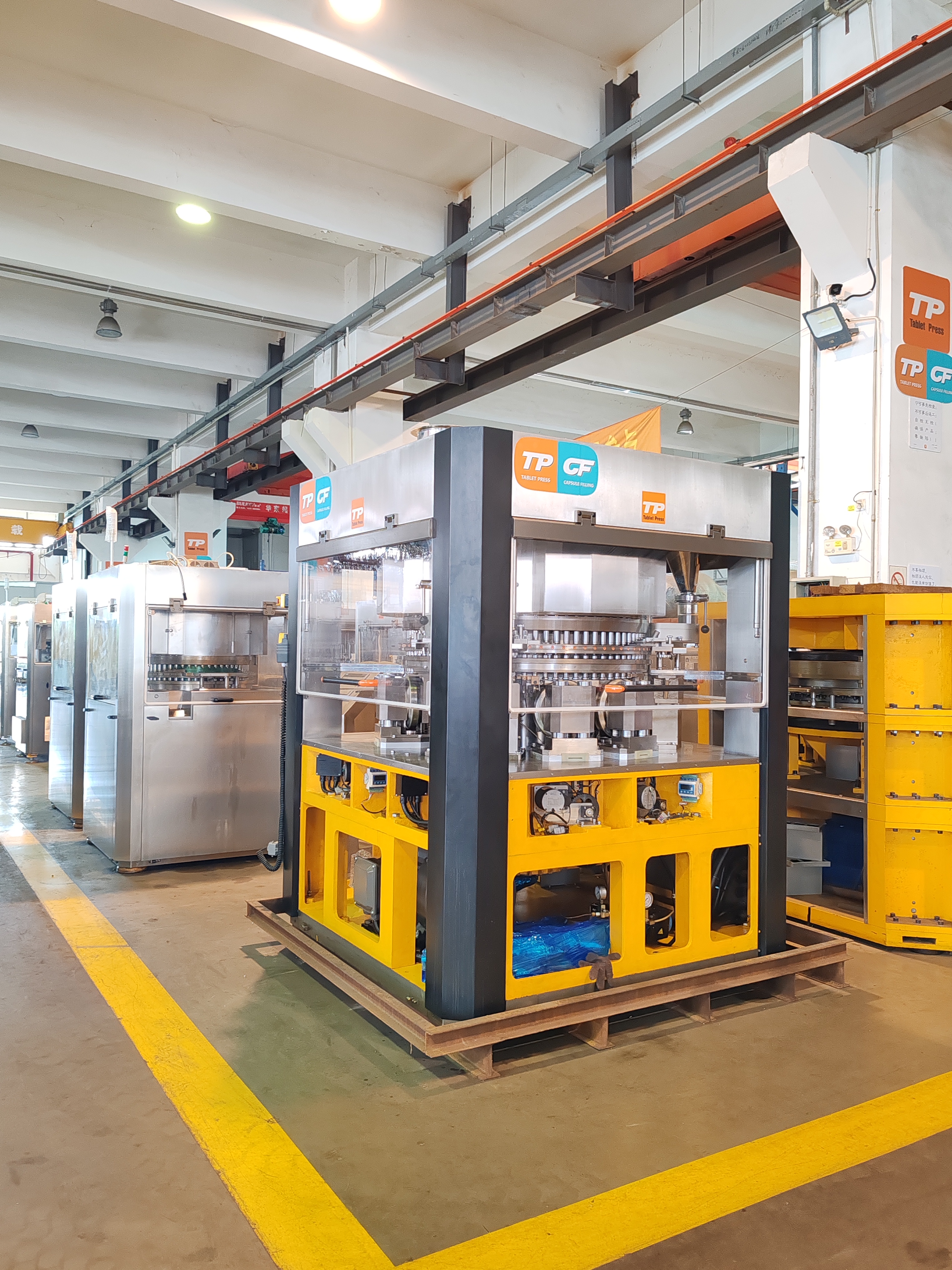
Multi-outlet configurations raise output without raising turret speed; the three-outlet GZPK1060 series is rated to 658,800 tablets per hour in single-layer mode.
Bilayer and Multi-Layer Machines
Multi-layer capability is specified at machine level rather than added later. The GZPK620i intelligent double-outlet high-speed press is delivered in a standard single-layer configuration with optional bilayer capability, at 45, 55 or 65 stations and 100 kN main compression. For large special-shaped tablets such as dishwasher, laundry, chlorine, water-softener salt and toilet-cleaner tablets, TPCF supplies the ZPTX420-17G strengthened version, a heavy-duty single- and bilayer press with 17 stations, 150 kN maximum main compression, 100 kN pre-compression, tablet thickness of 9–14 mm and a filling depth of 32–33 mm. For three-layer tablets, the ZPT680C triple-layer composite press offers 3 layers with 150 kN combined main compression and output from 9,720 to 72,000 tablets per hour.
Tooling and Auxiliary Equipment
Tooling determines what a press can physically produce. TPCF manufactures custom punches and dies to technical drawings or physical samples, covering D, B, BB, BBS, ZP and ZPT standards. Punches are made from S7 or 6CrW2Si, dies from D2 or GCr15, and optional chrome, CrNi, TiNi and DLC punch coatings are available; dies themselves are not coated.
Around the press, TPCF supplies a QVC-3 vacuum conveyor for feeding granules to the tablet press hopper, an XCJ-1.1 industrial dust collector for extracting residual material from the die table and production environment, a CF-1 anti-sticking powder sprayer for sticky sugar-based, effervescent or catalytic formulations, and an STF-250E PVA water-soluble film pillow packing machine for unit-dose household cleaning tablets. For formulations that cannot tolerate water or heat, the LG series roller compactor performs dry granulation across capacities from 1.5–15 kg/h (LG100) to 1,500–3,000 kg/h (LGS500), producing a finished particle size of 10–80 mesh.
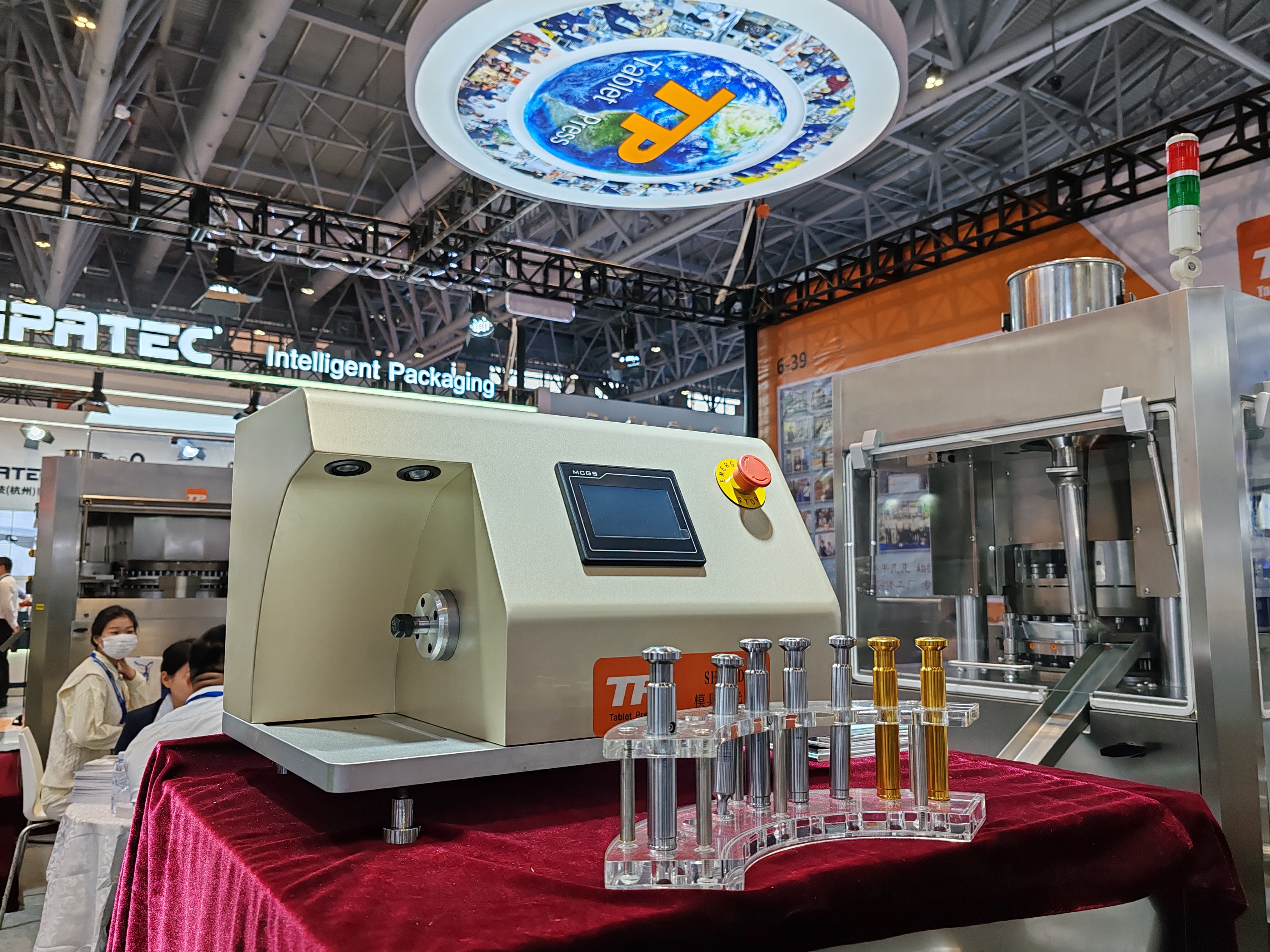
Tablet press punches and dies: tooling standard, punch material and coating determine wear life and product release.
A Step-by-Step Selection Workflow
The following sequence turns a long specification list into a short decision list. Each step produces one output that can be compared across suppliers.
- Define tablet geometry and dose. Establish maximum tablet diameter, thickness and shape, including special shapes. This sets the required filling depth and the tooling standard, whether that is 36.5 × 26.5 × 13 mm for a large household cleaning tablet or D/B/BB tooling for standard pharmaceutical shapes.
- Convert required output into stations and outlets. Decide whether the project needs 7,800 tablets per hour for trials or hundreds of thousands for commercial supply, then match that figure against station count and the number of discharge outlets. A double-outlet machine at the same turret speed produces more tablets than a single-outlet machine of identical station count.
- Confirm compression force and pre-compression. Maximum main compression ranges from 50 kN on compact laboratory machines to 150 kN on the heavy-duty bilayer press. Pre-compression figures of 16 kN, 20 kN, 30 kN or 100 kN indicate how much de-aeration the machine performs before main compression, which affects capping and hardness on difficult formulations.
- Decide the layer configuration. Single-layer, bilayer or triple-layer must be chosen before purchase. A standard single-layer high-speed press may offer optional bilayer capability, but triple-layer production requires a dedicated multi-layer machine such as the ZPT680C.
- Choose control and data features. Determine whether an HMI with pressure, thickness and filling-depth display is sufficient, or whether automatic lubrication, a force feeder, automatic weight control, reject-tablet removal, or electronic records supporting 21 CFR Part 11 and EU GMP Annex 11 expectations are required. These options change both the machine and its documentation package.
- Confirm materials and cleaning. Check the die table material and the product-contact materials. TPCF uses one-piece 2Cr13 stainless-steel die tables that require no nickel plating on several series, with SS316 force-feeder walls, impellers and hoppers and an SS304 enclosure on the heavy-duty bilayer machine.
- Fix the tooling standard. Confirm D, B, BB, BBS, ZP or ZPT compatibility, punch material (S7 or 6CrW2Si) and die material (D2 or GCr15), and whether coatings such as chrome, CrNi, TiNi or DLC are required. Tooling affects long-term running cost more than the machine frame does.
- Assemble the compliance file. Request GMP-related design documentation, CE documentation and quality certification. TPCF states that its equipment complies with GMP standards and that it holds EU CE certification and ISO certification for its tablet press machines. Buyers should obtain the certificate documents directly rather than relying on a website statement.
Why the die table deserves a separate question. Many tablet presses use a nickel-coated cast iron die table. If the nickel layer chips or wears through, the cast iron beneath can be exposed to the product and can corrode. A die table machined from one piece of 2Cr13 stainless steel removes the coating layer entirely: there is no plating to delaminate, and the table can be reground and returned to service rather than stripped and re-plated. TPCF machines several rotary tablet press series with one-piece 2Cr13 die tables that require no nickel plating.
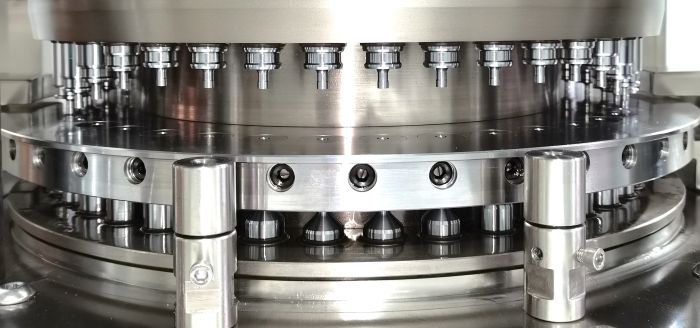
A one-piece 2Cr13 stainless-steel die table: no nickel coating to chip, and no plated layer to strip before regrinding.
Typical Use Cases
High-volume pharmaceutical and nutraceutical production. Multi-shift GMP tablet production uses the GZPK, GZPX, GZP, ZPT and ZPTY rotary tablet presses with tablet press punches and dies, a vacuum conveyor for centralised feeding and a dust collector for dust containment. The objective is stable tablet weight and hardness across long runs, with quick tooling changeover and easy cleaning between products.
Formulation development and pilot batches. R&D groups work with frequent formulation changes, small material batches and strict cleaning between trials. The ZPT168 compact press, the ZPTX226 R&D press with 16 kN pre-compression, and custom punches and dies made to drawings or physical samples support this stage. Method development on a laboratory press also produces the compression data that later informs commercial-machine settings.
Household cleaning tablets. Dishwasher, laundry, chlorine, water-softener salt and toilet-cleaner tablets are large, high-compression products, frequently bilayer and often corrosive. A matched line uses the ZPTX420-17G bilayer press, a CF-1 anti-sticking powder sprayer, an STF-250E PVA water-soluble film packing machine, a QVC-3 vacuum conveyor and an XCJ-1.1 dust collector, with automatic operation from powder feeding through to individual-dose packaging.
Effervescent, catalyst and other sticky or sensitive formulations. Sugar-based, effervescent and catalytic materials tend to stick to punch faces. The CF-1 sprayer applies a thin film of magnesium stearate or another anti-sticking powder to the upper and lower punches to reduce sticking. Where the formulation is heat- or moisture-sensitive, dry granulation on an LG series roller compactor can be used upstream of the press.
TPCF states that its tablet presses can also produce seasoning and broth cubes, fertiliser tablets, mint candy tablets, bath bomb tablets, naphthalene and camphor tablets, veterinary tablets, resistor tablets and Raschig rings. That breadth is a reminder that tablet press covers far more than pharmaceuticals, and that tablet geometry, not the industry label, usually determines the machine specification.
Model Comparison Table
| Machine class | Representative models | Stations | Max. main compression | Typical output | Best suited to |
|---|---|---|---|---|---|
| Compact / small batch | ZPT168-5 / ZPT168-7 / ZPTX226-10 / ZPT226-12 | 5 / 7 / 10 / 12 | 50 kN | 7,800–21,600 tablets/h | Small-batch and pilot production, 220 V single-phase sites |
| R&D with pre-compression | ZPTX226-8 / -16 / -17 / -19, ZPT226-21 | 8 / 16 / 17 / 19 / 21 | 80 kN (16 kN pre) | 14,400–44,100 tablets/h | Formulation development and scale-up |
| Single-outlet medium speed | GZPX370i-26 / -32 / -40 / -50 | 26 / 32 / 40 / 50 | 100 kN (16 kN pre) | 62,400–180,000 tablets/h | Mid-volume pharmaceutical production |
| Single-outlet high speed | GZPK370i-26 / -32 / -40 / -50 | 26 / 32 / 40 / 50 | 100 kN (30 kN pre) | 124,800–330,000 tablets/h | High-volume single-layer production |
| Heavy-duty single outlet | ZPTX340-24 / -29 / -36 | 24 / 29 / 36 | 120/100 kN (20 kN pre) | 43,200–75,600 tablets/h | Larger tablets requiring higher force |
| Double outlet | ZPTX420-29 / -35 / -41 / -45; ZPTY550-35 / ZPTY500-43 / -53 / -59 | 29–45; 35–59 | 120/100 kN; 100 kN (20 kN pre) | 104,400–205,200; 159,600–318,600 tablets/h | Higher output without higher turret speed |
| High-speed double outlet | GZPK620-45 / -55 / -65; GZPK720-51 / -65 / -83 / -99 | 45–65; 51–99 | 100 kN (30 kN pre); 100/100 kN | 378,000–624,000; 306,000–712,800 tablets/h | Large-scale commercial production |
| Three-outlet high speed | GZPK1060-76 / -95 / -113 / -122 | 76 / 95 / 113 / 122 | 100/100 kN | 342,000–658,800 tablets/h single-layer; 114,000–219,600 tablets/h triple-layer | Maximum single-layer output or triple-layer composite tablets |
| Heavy-duty bilayer | ZPTX420-17G strengthened version | 17 | 150 kN (100 kN pre) | approx. 8,000–16,320 tablets/h | Large special-shaped dishwasher, laundry, chlorine and salt tablets |
| Triple-layer composite | ZPT680C-27 / ZPT680C-48/58/68 | 3 layers | 150 kN combined (100 kN pre for layers 1 and 2) | 9,720–21,060 or 28,800–72,000 tablets/h | Three-layer pharmaceutical and nutraceutical tablets |
Figures are taken from TPCF model specifications; actual output depends on tablet size, formulation and layer configuration.
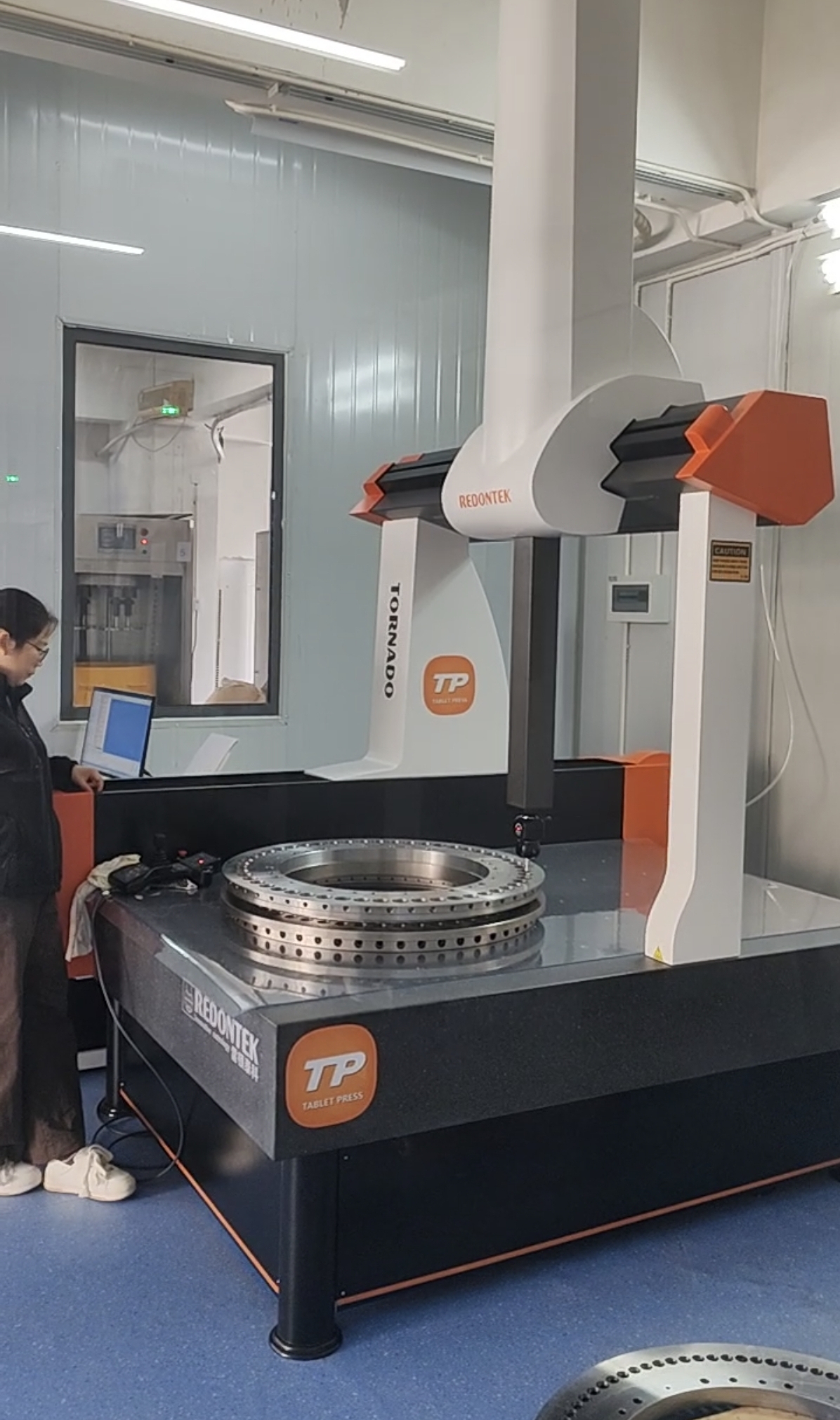
Turret and tooling accuracy is verified on a coordinate measuring machine, a specification point worth raising with any supplier because turret accuracy affects tablet weight variation.
Frequently Asked Questions
1. What compliance documentation should be checked when buying a rotary tablet press?
Ask for GMP-related design documentation, CE conformity documentation and quality management certification. TPCF states that its equipment complies with GMP standards and that it holds EU CE certification and ISO certification for its tablet press machines. Two regulatory points belong on the same checklist: Regulation (EU) 2023/1230 replaces Directive 2006/42/EC and applies from 20 January 2027, and CE marking remains mandatory for machinery placed on the EU market. Where the press control system stores batch data, buyers targeting the United States should review 21 CFR Part 11 expectations, and EU buyers should review Annex 11 to the EU GMP guide, which applies a risk-based approach to computerised systems. Certificate documents should be obtained directly from the supplier rather than accepted as a website statement.
2. What output and configuration options exist in a rotary tablet press range?
A full range normally covers several production stages. TPCF's range starts with a 5–12 station compact press at 50 kN and 7,800–21,600 tablets per hour, continues through an 8–21 station R&D press with 16 kN pre-compression, then moves to single-outlet machines from 62,400 to 330,000 tablets per hour, double-outlet machines from 104,400 to 712,800 tablets per hour, and a three-outlet machine rated at 342,000–658,800 tablets per hour in single-layer mode. Bilayer capability is available as an option on the GZPK620i series and as a dedicated heavy-duty configuration on the ZPTX420-17G. Maximum main compression force across the range runs from 50 kN to 150 kN.
3. What drives the cost of a rotary tablet press?
No verified price list is published for this category, but the specification variables that move cost are visible in the model data. Station count and the number of discharge outlets set the output ceiling; maximum main compression force (50 kN to 150 kN) and pre-compression force (16 kN to 100 kN) determine the structural class of the machine; layer capability such as single, bilayer or triple-layer requires dedicated compression and feeding arrangements; and control options such as HMI parameter adjustment, automatic lubrication, force feeding, automatic weight control and reject-tablet removal add instrumentation. Tooling is a separate line item: tooling standard (D, B, BB, BBS, ZP, ZPT), punch material (S7 or 6CrW2Si), die material (D2 or GCr15) and optional coatings (chrome, CrNi, TiNi, DLC) all affect the total. Specify all five items before requesting a quotation, otherwise the quotes will not be comparable.
4. Can tooling and small batches be validated before full-scale production?
Yes, and this is normally done in two ways. First, tooling is made to order: TPCF manufactures custom punches and dies to technical drawings or physical samples, covering D, B, BB, BBS, ZP and ZPT standards. Second, small batches are produced on laboratory-scale machines, either the ZPT168 compact press with 5–12 stations and 50 kN main compression, or the ZPTX226 R&D press with 16 kN pre-compression, before parameters are transferred to a production machine. Auxiliary equipment supports the same logic: a QVC-3 vacuum conveyor feeds material to the hopper, and an XCJ-1.1 dust collector extracts residual material from the die table so trials are not contaminated by the previous formulation.
5. How can buyers assess a China tablet press manufacturer's supply capability?
Look for production indicators rather than general claims. TPCF states a 15,000 m² manufacturing facility, more than 200 CNC machine tools including engraving machines, coordinate measuring machines and coordinate grinders, an annual production capacity of 1,500 sets, and a delivery rate of 80 to 120 tablet presses and capsule filling machines per month. The company also states that approximately 50% of its products are exported, with markets in Asia, South Africa, the Middle East, the EU, Russia, and North and West Africa. Export exposure is a reasonable proxy for familiarity with CE and GMP documentation requirements. Request the current machine lead time, tooling lead time and spare-parts list in writing, because those three items determine project timing more than the headline specification does. The company was registered under its current name in 2009 and reports a longer engineering heritage through its predecessor workshops, so ask for the specific factory and engineering documentation you need rather than relying on age claims alone.
Conclusion: From Discovery to a Comparable Shortlist
Rotary tablet press selection narrows quickly once four variables are fixed: tablet geometry, required output, compression force with pre-compression, and layer configuration. Compliance documentation and tooling standard complete the picture, and both should be confirmed in writing before a purchase order is raised.
The value of a structured workflow is that it exposes mismatches early. A compact laboratory press cannot be scaled by adding stations, and a single-layer high-speed press cannot become a three-layer machine. Matching the machine class to the production stage, and matching tooling and auxiliary equipment to the formulation, is what makes specifications comparable between suppliers.
For buyers who want to review the complete model range, the TPCF product portfolio and specification pages are published at www.tp-tabletpress.com. A downloadable product brochure covering the tablet press and capsule filling machine range is available below.
Next Step: Specification Review, Tooling Request or Quotation
If you are at the research stage, send your tablet geometry (diameter, thickness, shape), target output per shift, layer configuration and required tooling standard. TPCF can reply with the matching machine class, the tooling specification and a quotation request list.
Email: michael@stctp.com
WhatsApp / Tel: +86 180 1702 7102
Website: www.tp-tabletpress.com
Address: No. 159 Zhujiabang Rd., Xiao Kun Shan Town, Songjiang District, Shanghai, China
Download the product brochure: TPCF tablet press and capsule filling machine brochure (PDF)
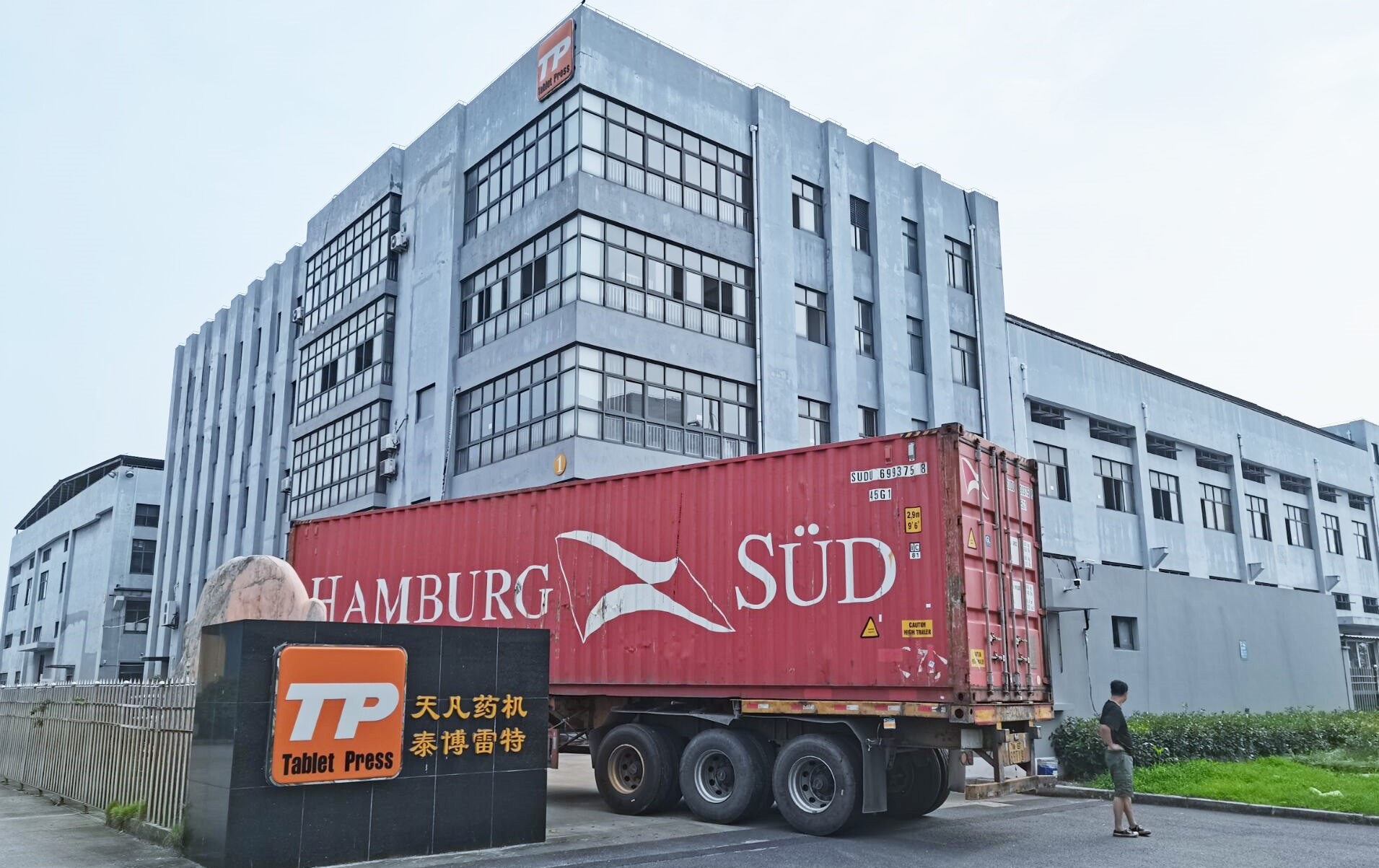
Tablet presses prepared for shipment: request the current delivery schedule and spare-parts list together with your quotation.
Have Questions or Need More Details?
Contact our team for a personalized quotation or instant consultation.
Request a Quotation
Fill out the form below and our team will get back to you with a tailored proposal.
WhatsApp Direct Chat
Prefer to chat in real-time? Message us on WhatsApp for instant assistance & quick answers.
- Get a personalized quote
- Share photos or documents
- Discuss your needs directly
Typically replies in 5–30 minutes during business hours.