
Tablet Press Die Table: 2Cr13 Stainless Steel vs Traditional Cast Iron
Changing the die table of a rotary tablet press from nickel-coated cast iron to one-piece 2Cr13 martensitic stainless steel alters more than the surface finish. It removes a plated coating from the product-contact path, raises the hardness of the die bores and punch guide bores, improves dimensional stability under compression load, and leaves the table regrindable instead of re-platable. The trade-off is cost: a 2Cr13 die table costs about four times as much as a cast iron die table, while its documented service life is about four times longer.
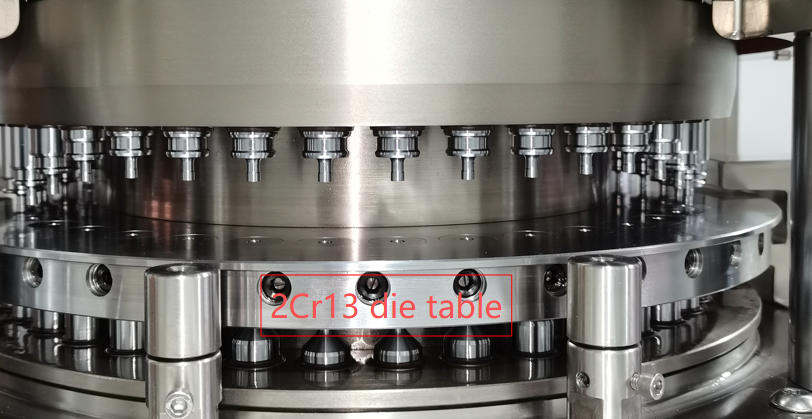
The die table — the turret surface that carries the dies and guides the punches — is the reference geometry of the whole compression cycle. Every tablet is formed at a fixed depth relative to that surface, so any change in flatness, bore diameter or bore alignment is transmitted directly into tablet weight, thickness and hardness.
Shanghai Tablet Press Mechanical Components Co., Ltd. (TPCF), a tablet press and tooling manufacturer based in Songjiang District, Shanghai, specifies one-piece 2Cr13 stainless steel die tables on several rotary models. This article explains what actually changes for a buyer when that material replaces the traditional nickel-coated cast iron, and how to write the difference into a purchase specification.
The Problem: What Fails on a Nickel-Coated Cast Iron Die Table
Cast iron is a sound structural material for a turret, but it is not corrosion resistant and it is not hard enough at the die bores to survive decades of die changes. The conventional answer is a nickel coating: a thin plated layer over a softer substrate. That construction introduces three failure modes that a buyer should recognise before comparing quotations.
Coating delamination. The nickel layer is a surface coating, not part of the base metal. Under continuous mechanical friction and impact — die insertion, die removal, punch guidance — the coating can crack, chip or peel. When it does, fragments enter the powder flow and the machine becomes a contamination source rather than a production asset.
Under-film corrosion. Electroplated cast iron carries microscopic pinholes and micro-cracks. Moisture and cleaning agents pass through these defects and attack the iron underneath, producing hidden corrosion beneath an apparently intact surface. The visible result is loss of flatness on the die table face.
Soft substrate once the coating is breached. Cast iron depends entirely on the thin nickel layer for wear resistance. Once that layer is scratched through at a die bore, the softer iron beneath wears quickly. Bore wear leads to eccentricity between punch and die, and eccentricity shows up downstream as tablet weight variation.
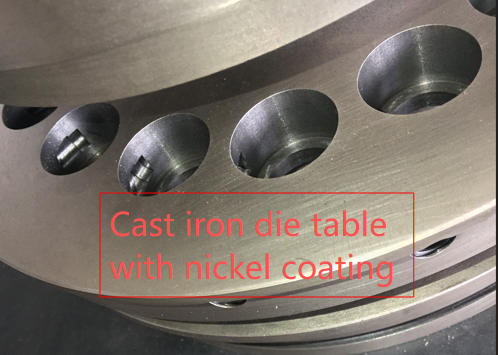
There is a fourth, quieter problem: refurbishment. Die tables need occasional skimming or regrinding to restore flatness. Grinding a nickel-coated table removes the protective layer and forces a full strip-and-replate cycle. The table leaves production for a plating line, not for a grinder.
Industry Background: Why Die Table Material Became a Specification Item
Historically, die table material sat below the buying radar. Procurement compared station count, maximum compression force, tablet diameter range, output per hour and motor rating, and treated the turret as an assumed constant. That assumption is weakening for three reasons.
Cleaning regimes have become more aggressive. Solid-dosage facilities increasingly treat the press as a cleanable surface rather than a machine that is merely wiped down. Water-based cleaning, humid environments and residues from acidic or hygroscopic formulations all reach the die table first.
Product-contact scrutiny has increased. A plated layer on a product-contact surface is a documented risk that quality teams now ask about directly. A homogeneous alloy with no coating to flake is easier to defend in a supplier qualification file than a coating that must be inspected for integrity.
Asset lifetimes now span regulatory cycles. Under Regulation (EU) 2023/1230, the successor EU machinery framework applies from 20 January 2027, replacing Directive 2006/42/EC. A tablet press purchased today will be re-assessed against that framework during its working life. When a machine is planned around a ten-year horizon, component choices that determine whether the turret is still within tolerance late in that horizon become part of the original decision, not an afterthought.
Long-horizon buyers — generic manufacturers running annual supply contracts, CMOs scheduling multi-year campaigns, and distributors holding machines in a rental or resale fleet — are the group most exposed to this shift. They are not buying a die table; they are buying the number of years before the turret has to come out.
Detailed Solution: What Changes When the Die Table Is 2Cr13
2Cr13 is a martensitic stainless steel, equivalent to AISI 420, containing 12% to 14% chromium. It is heat treatable, machinable to tight tolerance, and — critically for this application — it can be the die table itself rather than a substrate for a coating.
Corrosion resistance from the base metal, not from a coating
The chromium content forms a self-healing passivating oxide layer. The turret therefore resists rust and pitting when exposed to powder dust, moisture and cleaning agents, and the die mounting holes and table surface stay clean. On a cast iron table, the same exposure produces rust that can seize die inserts, contaminate product and make cleaning difficult.
Higher hardness and deeper wear resistance
Through quenching and tempering, 2Cr13 reaches a hardness of approximately HRC 40–50 — substantially harder than cast iron. The die bores and punch guide bores resist wear from repeated die insertion and removal and hold precise alignment over millions of cycles. Wear resistance is uniform through the full depth of the table, so a scratch or a worn spot does not expose a softer layer underneath.
Dimensional stability under load
2Cr13 has a finer, more uniform microstructure than cast iron, so it holds tight tolerances under pressure and responds predictably to precision machining. In practice this means the die table face stays flat and the bore spacing stays consistent as the press runs — the condition that keeps tablet weight stable across a long campaign.
Interaction with punches and dies
The die table and the tooling are a matched pair. When the table is harder and its bores stay accurate, punch and die service life is prolonged, because the tooling is no longer working against a wearing, deforming reference surface. On a cast iron table, bore wear shows up first as alignment drift and then as tablet weight variation — and the tooling is usually blamed before the turret is.
Surface condition, cleaning and product contact
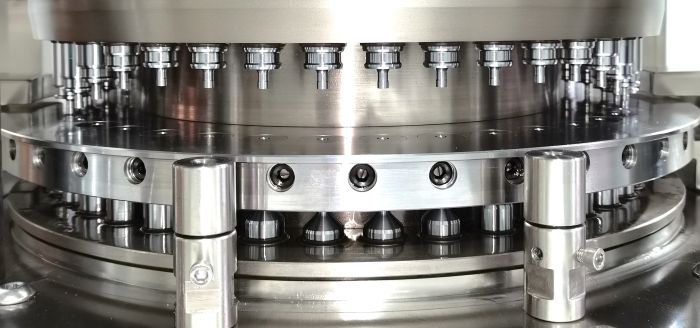
Because the die table is a single solid alloy, there is no coating to wear away or flake off and no under-film corrosion path. Cleaning acts on the material itself, not on a thin protective skin. That simplifies cleaning validation arguments and removes one contamination mechanism from the risk assessment.
Refurbishment: grinding instead of re-plating
A 2Cr13 table that has seen superficial wear can be ground directly and returned to service. A nickel-coated table has to be stripped and re-electroplated to restore both flatness and protection. For a machine that is expected to run for a decade, this is the difference between a maintenance task and a supply interruption.
The economics, stated plainly
A 2Cr13 die table costs roughly four times more than a cast iron die table, and its documented service life is about four times longer. Taken alone, those two figures read as a wash. They are not, because the die table is only one of the consumables affected: punch and die service life is also prolonged on a 2Cr13 table, since the tooling runs against a harder and more accurate reference. Weighing a four-times cost against a four-times life, plus reduced tooling consumption and fewer refurbishment cycles, is the correct comparison — not comparing two die tables line by line on the quotation.
Where cast iron still makes sense
A four-times cost premium has to be justified. Where the formulation is non-corrosive, cleaning is dry and manual, throughput is low, and the machine is not intended to run multi-year campaigns, a nickel-coated cast iron die table remains a workable choice. The 2Cr13 case is strongest wherever moisture, corrosive ingredients, aggressive cleaning or high cycle counts are part of normal operation.
Step-by-Step: How to Specify Die Table Material in an Inquiry
The material difference only reaches the buyer if it is written into the specification. These steps convert the technical comparison into an inquiry that a supplier can answer unambiguously.
- State the product and the environment first. Describe the formulation type (effervescent, salt, cleaning tablet, catalyst, nutraceutical), the cleaning method, and whether the room is humid. The die table decision follows from these conditions, not from a preference for stainless steel.
- Name the material grade explicitly. Write “one-piece 2Cr13 stainless steel die table” into the specification. Do not accept “stainless steel” as a substitute — it does not define grade, hardness or construction.
- Say that no nickel plating is permitted. This single line removes the coating failure mode from the scope. Ask the supplier to confirm in writing that the die table has no plated layer.
- Ask for the heat treatment and hardness. Request the hardness range the die table is supplied at, and the heat treatment condition. A 2Cr13 table at approximately HRC 40–50 after quenching and tempering is the reference point for comparison.
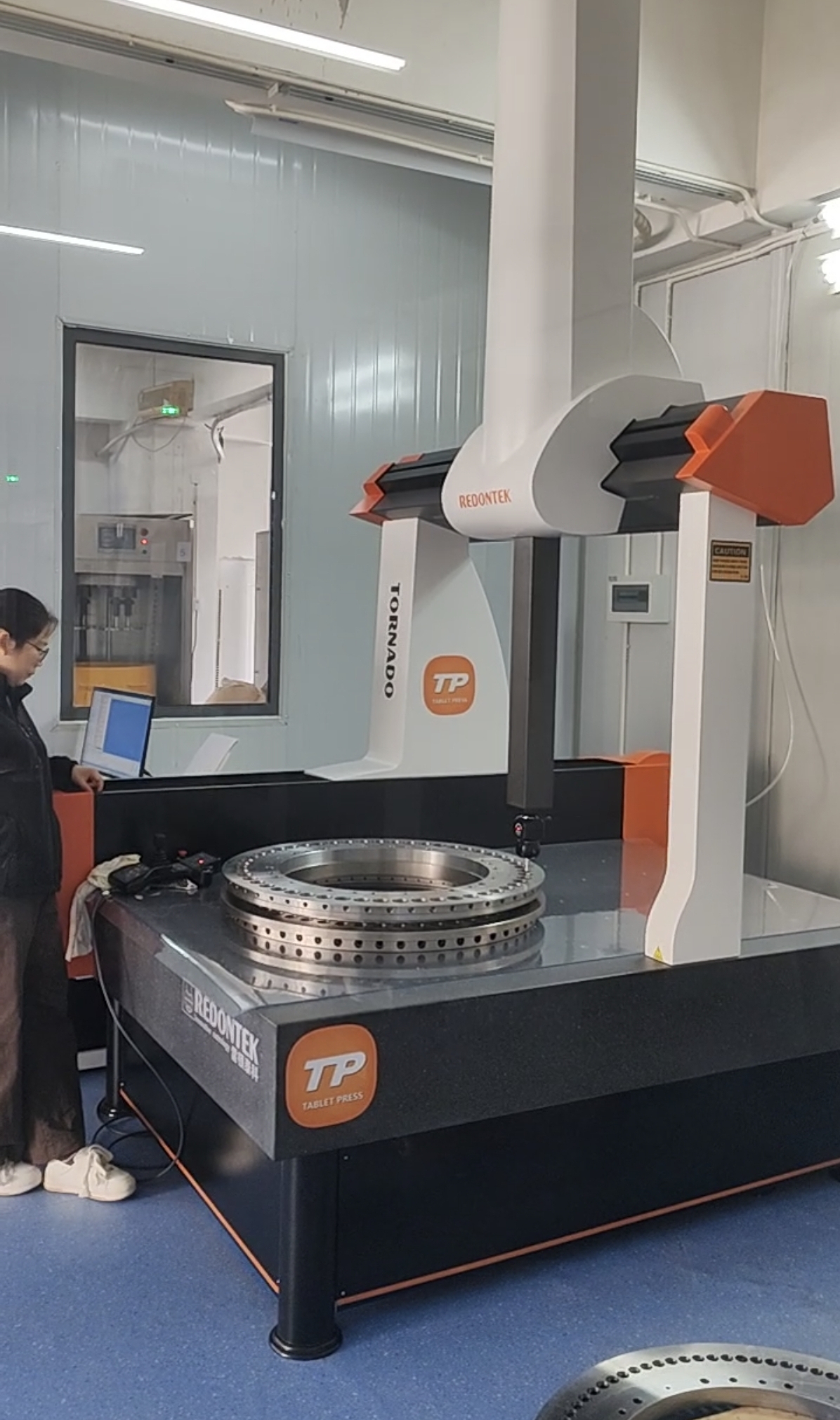
- Ask how bore accuracy is verified. Request the inspection method and the record that will be supplied with the machine. Coordinate measuring machine reports covering turret accuracy are the evidence to look for.
- Ask about the refurbishment route. Confirm whether the die table can be reground in service and what flatness can be restored. This is where the ownership cost settles over a ten-year horizon.
- Price the whole consumable set, not the table alone. Request die table cost alongside expected punch and die consumption, so the four-times cost and four-times life figures can be evaluated against tooling spend.
- Fix the acceptance and commercial terms. Agree the pre-shipment test, delivery term and payment schedule before the order, so material confirmation and machine acceptance are tied to the same document.
Use Cases: Where the Material Choice Actually Shows Up
Effervescent tablets
Effervescent formulations combine moisture sensitivity with acidic ingredients. A die table that resists rust and pitting, and that can be cleaned without stripping a coating, removes one contamination route in a product family where any metallic residue is unacceptable.
Salt, chlorine and household cleaning tablets
Salt tablets, chlorine tablets, dishwasher tablets and laundry detergent tablets all expose the turret to corrosive chemistry. Chloride attack is precisely the condition that ruins a cast iron turret, and precisely the condition where a 12%–14% chromium alloy earns its premium.
Catalyst and industrial tablets
Catalyst tablets, naphthalene tablets and similar industrial products are often run on long campaigns with abrasive powders. Uniform wear resistance through the full depth of the die table matters more here than surface hardness alone, because the table is expected to survive continuous production rather than intermittent batches.
Nutraceutical and vitamin production
Vitamin and supplement production combines high output with frequent product changeovers and wet cleaning. A die table that can be cleaned aggressively and reground when needed keeps changeover time from turning into refurbishment lead time.
R&D and small-batch scale-up
Laboratory and R&D presses are often bought once and used for years across many formulations, including aggressive ones. Specifying 2Cr13 at the R&D stage avoids discovering the cast iron limitation only after scale-up, when the die table is buried inside a validated production machine.
Long-run pharmaceutical supply contracts
Annual supply contracts are priced on uptime. Where a press must run multi-year campaigns with predictable output, the difference between a turret that holds alignment and one that drifts is a scheduling risk, not a maintenance line item.
Comparison Table: 2Cr13 Stainless Steel vs Nickel-Coated Cast Iron
| Selection parameter | One-piece 2Cr13 stainless steel | Cast iron with nickel coating |
|---|---|---|
| Construction | Homogeneous martensitic stainless steel (AISI 420 equivalent), 12%–14% chromium | Cast iron substrate with an electroplated nickel surface layer |
| Corrosion behaviour | Self-healing passivating oxide layer; resists rust and pitting | Rusts easily once exposed; pinholes and micro-cracks allow under-film corrosion |
| Hardness | Approximately HRC 40–50 after quenching and tempering | Soft substrate; wear resistance depends on the thin nickel layer |
| Wear resistance through depth | Uniform through the entire depth of the die table | Confined to the coating; rapid wear once the layer is breached |
| Coating failure risk | No coating, so no delamination pathway | Coating can crack, chip or peel and contaminate product |
| Dimensional stability | Fine, uniform microstructure; holds tight tolerances under pressure | Less stable; bore wear causes eccentricity and tablet weight variation |
| Effect on punch and die life | Higher accuracy and hardness prolong punch and die service life | Tooling works against a wearing reference surface |
| Refurbishment | Can be ground directly and returned to service | Regrinding strips the coating; requires strip and re-electroplate |
| Relative die table cost | About 4× the cast iron die table | Baseline |
| Relative service life | About 4× the cast iron die table | Baseline |
| Best suited to | All kinds of solid tablet production plants, particularly corrosive, humid or high-cycle duty | Low-duty, dry, non-corrosive applications with tight capital budgets |
TPCF applies one-piece 2Cr13 die tables, with no nickel plating, on the ZPT420, ZPTX420, ZPTX340, ZPTX226 and ZPT226 rotary tablet press models. Buyers evaluating these models should confirm the die table construction in the order specification rather than relying on the model number alone.
FAQ
Is a 2Cr13 die table compatible with GMP tablet production?
Yes, on the material side. A 2Cr13 die table removes the nickel plating layer from the product-contact area, so there is no coating that can chip or peel into the powder flow, and the homogeneous alloy can be cleaned and reground. TPCF states that its tablet press machines comply with GMP standards and that it holds EU CE and ISO certification; buyers should still request the certificate copies and compliance documentation during supplier qualification.
Which tablet press models use a one-piece 2Cr13 die table?
For TPCF rotary tablet presses, the die table is made of one-piece 2Cr13 stainless steel and requires no nickel plating on models ZPT420, ZPTX420, ZPTX340, ZPTX226 and ZPT226. These models cover double-outlet, heavy-duty single-outlet, compact single-outlet and R&D configurations. Because material specifications can vary between orders, the die table grade should be confirmed in the purchase specification.
Why does a 2Cr13 die table cost about four times more than a cast iron one?
The cost difference comes from the material itself and from the machining and heat treatment needed to bring a martensitic stainless steel to the required hardness and tolerance. The comparison should not stop at the component price: the documented service life of a 2Cr13 die table is about four times that of a cast iron die table, and punch and die service life is also prolonged because the tooling runs against a harder, more accurate reference surface.
What are the minimum order quantity, delivery terms and payment terms?
TPCF states an MOQ of 1 unit, delivery terms of FOB, acceptance based on a pre-shipment test, and payment of 30% in advance with 70% after the pre-shipment test but before shipment. Production capacity is around 1,500 sets per year, with 80 to 120 sets of tablet presses and capsule filling machines deliverable each month.
How do I confirm a Chinese GMP tablet press supplier for annual pharmaceutical supply?
Work through four checkpoints. First, documentation: GMP compliance statement, CE and ISO certificate copies, and the machine's technical file. Second, specification: the die table grade (one-piece 2Cr13, no nickel plating), hardness range and bore accuracy verification method written into the order. Third, acceptance: a pre-shipment test with inspection records, plus agreed FOB terms and a 30/70 payment schedule. Fourth, continuity: annual capacity and monthly delivery capability, so that spare die tables and tooling remain available across the contract period. TPCF supplies tablet presses, tablet press punch and dies and capsule filling machines, and exports to Asia, South Africa, the Middle East, the EU, Russia, and North and West Africa. To start a specification review, send your tablet product, cleaning regime and target output through the TPCF website or request the product catalogue below.
Conclusion
The die table material question is really a question about what the turret is expected to survive. Nickel-coated cast iron places wear resistance in a thin surface layer and relies on that layer staying intact; once it is breached, the substrate corrodes, wears and drifts out of tolerance. One-piece 2Cr13 puts wear resistance and corrosion resistance into the body of the component, keeps the die bores accurate over millions of cycles, protects punch and die life, and can be reground instead of re-plated.
That difference costs about four times as much up front and returns roughly four times the service life, before counting the tooling and downtime effects. For plants running corrosive formulations, wet cleaning or multi-year supply contracts, the material is a lifecycle decision. For low-duty, dry, non-corrosive operation, cast iron remains defensible — and saying so is part of an honest comparison.
The practical takeaway for a buyer is short: put the grade, the no-plating requirement, the hardness range and the accuracy verification method into the inquiry. A die table that is specified is a die table that can be inspected.

Specify the die table before you compare prices
Send your tablet product, cleaning method and target output, and TPCF will confirm the die table material, hardness range and inspection records for the matching rotary tablet press model. MOQ is 1 unit, delivery is FOB, and acceptance is based on a pre-shipment test.
Download the catalogue: TPCF product catalogue (PDF)
Website: www.tp-tabletpress.com | Email: michael@stctp.com | WhatsApp: +8618017027102
Have Questions or Need More Details?
Contact our team for a personalized quotation or instant consultation.
Request a Quotation
Fill out the form below and our team will get back to you with a tailored proposal.
WhatsApp Direct Chat
Prefer to chat in real-time? Message us on WhatsApp for instant assistance & quick answers.
- Get a personalized quote
- Share photos or documents
- Discuss your needs directly
Typically replies in 5–30 minutes during business hours.