
Sticking Tablets on a High-Speed Rotary Tablet Press: A Problem–Solution Guide
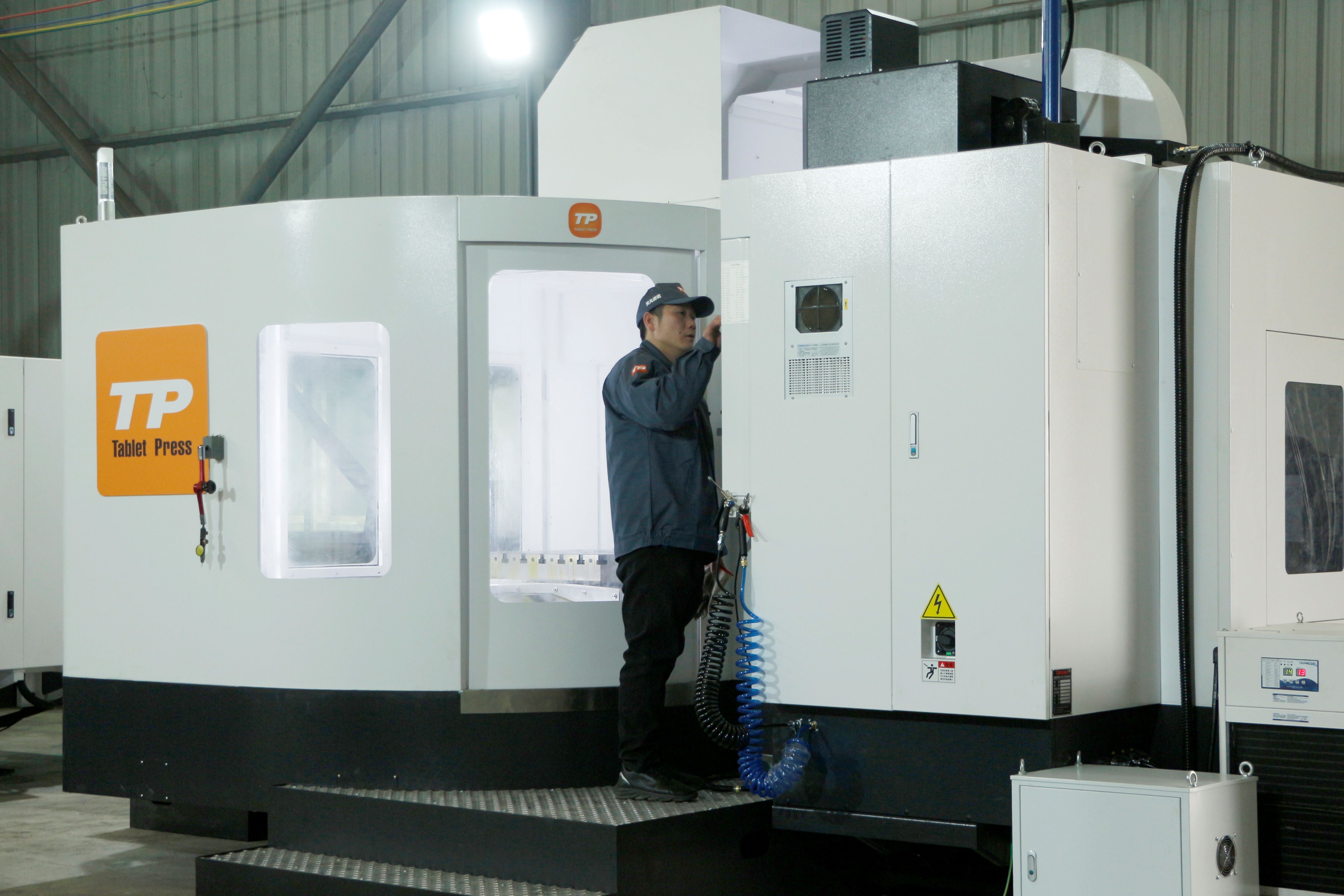
Sticking and picking on a high-speed rotary tablet press are almost always caused by three variables changing at the same time: the formulation's tendency to adhere to the punch face and die wall, the surface condition of the punches, dies and die table, and the compression settings held on the HMI. The practical fix path interrupts that combination in a fixed order — add an anti-sticking powder sprayer, verify the tablet press punches and dies, then adjust main compression, filling depth, individual punch pressure and turret speed from the HMI. Automatic weight control (AWC) and automatic reject-tablet removal hold the process inside its window, while an industrial dust collector and vacuum conveying keep the compression zone clean enough for the settings to stay repeatable.
This article follows one scenario: a pharmaceutical or nutraceutical manufacturer running a high-speed rotary tablet press where a sticky formulation produces picking, sticking and a rising reject-tablet rate. It is written for buyers at the evaluation stage — the point where a rotary tablet press has been shortlisted, a difficult formulation has to run on it, and the operating window has to be found before the machine is qualified and handed to production.
Problem Definition: What Picking and Sticking Actually Cost a High-Speed Line
Picking is material adhering to the punch tip — most visibly inside letters, logos or deep engravings — and being pulled out of the tablet surface as the punch withdraws. Sticking is adhesion across the flat punch face or along the die wall, which raises ejection force and leaves torn, scored or dull tablet surfaces. Both are adhesion events, and both respond to three conditions: the pressure applied, the time the material spends under that pressure (dwell time), and the temperature generated at the punch face.
A high-speed rotary tablet press pushes all three conditions at once. Turret speed shortens dwell time, compression force is set higher to reach the target hardness at that speed, and the number of punch-to-powder contacts per hour is at its maximum. A formulation that runs acceptably on a medium-speed, laboratory or R&D tablet press can therefore produce a reject spike the moment it is transferred to a high-speed machine — not because the formulation became worse, but because the operating window narrowed.
The cost appears in four places: the reject-tablet rate, the frequency of production stops for cleaning, weight variation across stations, and accelerated wear or damage to punches and dies. Adhesion also becomes a quality issue rather than only an efficiency issue, because material that stays on a punch face is material that is no longer inside the tablet you intended to produce.
| Symptom on the tablet | Most likely process or tooling cause | First corrective action |
|---|---|---|
| Crater or missing material at the logo or engraving | Material adhering to the punch tip (picking) | Inspect and polish or replace the punch; start the anti-sticking powder sprayer |
| Torn edge or vertical scoring on the tablet band | Die bore wear or scoring; punch-to-die clearance out of range | Verify dies and clearance before touching any HMI parameter |
| Weight drifting across stations | Filling depth variation, uneven die table flatness | Check die table surface condition and reset filling depth |
| Rejects cluster immediately after a speed increase | Turret speed raised before dwell-dependent settings were re-tuned | Return to the previous speed, then re-tune compression one step at a time |
| Rejects cluster at the start of a run and then settle | Room humidity or punch face temperature drift | Stabilize room conditions and check lubricant or spray rate |
Before changing anything, record a baseline: reject rate per fixed interval, tablet weight, hardness, the station numbers where rejects concentrate (where the machine reports per-station data), and photographs of the punch faces. Every action in this guide is judged against that baseline, and the same record becomes the evidence used during qualification.
Industry Background: Why Sticky Formulations Surface at Scale
The tablet press machines market was estimated at USD 1.52 billion in 2025 (Global Market Insights), with Fette Compacting holding the largest global market share at over 9% in the same year. Below that top tier, buyers for specialty, small-batch and non-pharmaceutical tablet production work with a much wider group of suppliers — which is why specification detail, not brand recognition, decides the outcome when the formulation is difficult.
Regulatory pressure is another reason the fix path belongs at the evaluation stage rather than after installation. CE marking is mandatory for machinery placed on the EU market. Directive 2006/42/EC is the current framework, and Regulation (EU) 2023/1230 repeals and replaces it with effect from 20 January 2027, which turns conformity documentation into a planning item rather than an afterthought. Where a tablet press is connected to batch records or electronic signatures, 21 CFR Part 11 in the United States and EU GMP Annex 11 (Computerised Systems) set the data-integrity expectations for those records. For customs and landed-cost planning, tablet presses have been classified under HS 8479.89.9897 by US Customs ruling NY h89507.
Formulation practice pushes in the same direction. Adhesion problems are most common where the formulation contains hygroscopic ingredients, low-melting-point components, a high fines fraction, or actives that are highly sensitive to lubricant level — the profile found in effervescent tablets, vitamin and nutraceutical formats, salt tablets and large household tablets. That is why a problem-solution sequence, rather than a machine-only specification, is what produces a stable production run.
The Fix Path: Five Workstreams Around One Sticking Problem
1. Add an anti-sticking powder sprayer to the compression zone
An anti-sticking powder sprayer delivers a fine, controlled film of anti-adherent powder to the punch faces during the run, so the material meets a low-surface-energy interface instead of bare steel. It does not change the formulation and it does not change the tablet's dimensions — it changes the surface the material is pressed against, which is where picking begins.
Treat the sprayer as a specification item rather than an accessory. When a machine is shortlisted, ask the supplier to confirm whether a powder sprayer is available for the specific model, where it is mounted relative to the feeder and the compression rollers, and how the spray rate is controlled from the HMI. On a high-speed rotary tablet press, a spray rate that cannot be adjusted as room humidity changes simply becomes a new source of variation.
2. Verify the tablet press punches and dies before tuning anything else
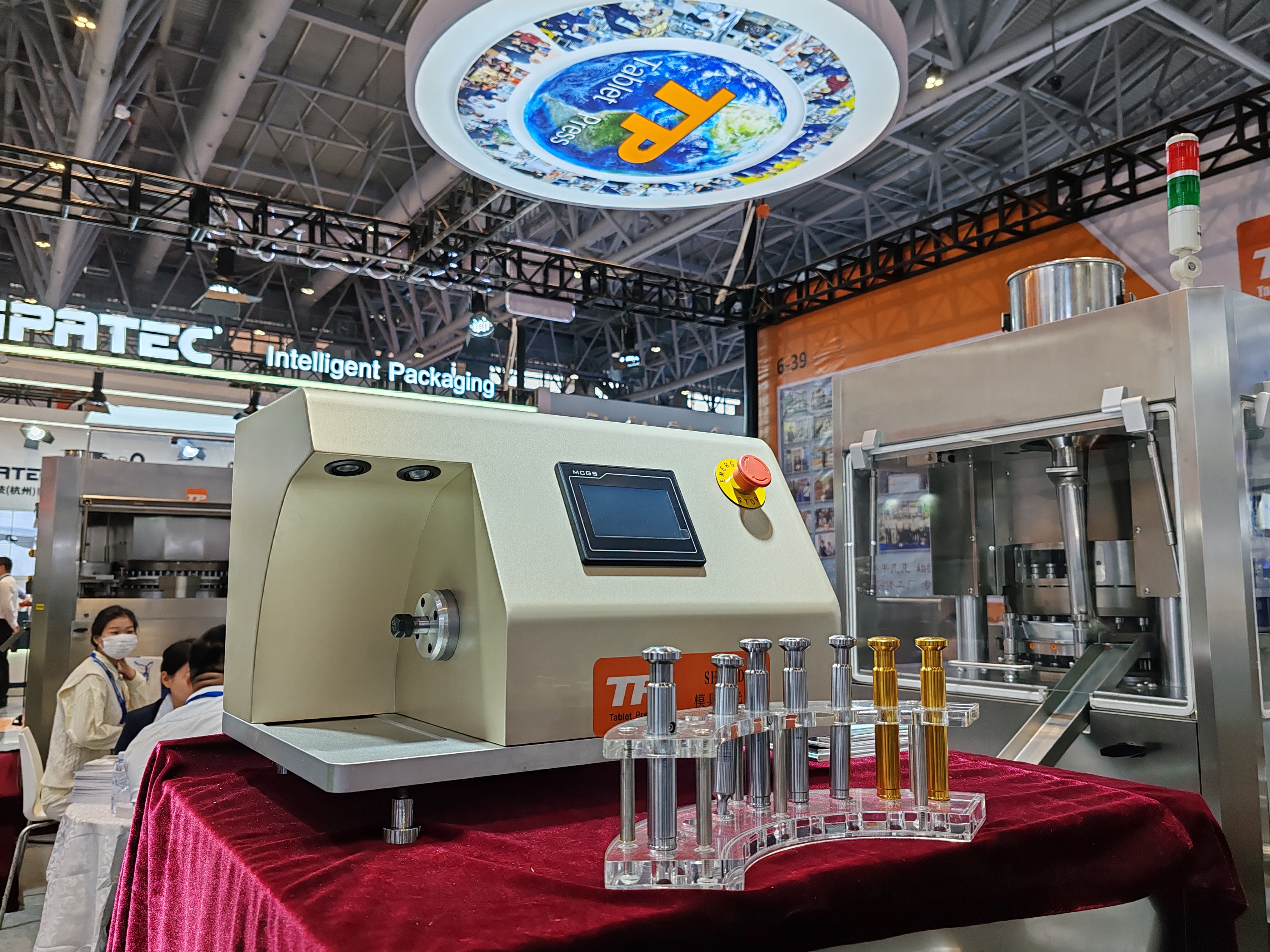
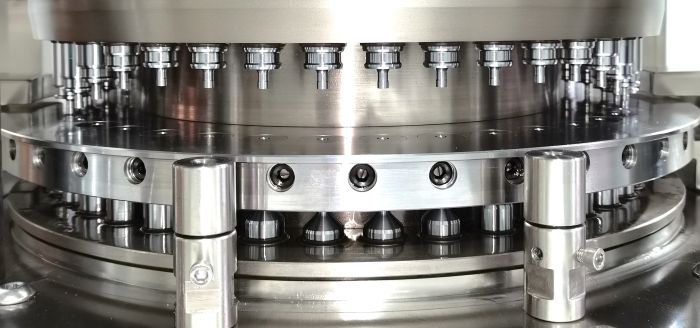
Tooling condition sets the ceiling on what parameter adjustment can achieve. A worn punch face, a polished-away tip radius or a scored die bore will produce adhesion no HMI setting can remove. Shanghai Tablet Press Mechanical Components Co., Ltd. (TPCF), a Shanghai-based manufacturer of tablet press machines, tablet press punches and dies, capsule filling machines and tablet de-dusters, produces punches, dies and tablet press moulds in-house, so replacement tooling and special shapes come from the same source as the machine.
Inspect five things: punch face polish and any wear ring; engraved tips and small radii; die bore straightness and scoring; punch-to-die clearance; and the die table surface. Die table material matters here. TPCF tablet presses use a one-piece 2Cr13 martensitic stainless steel die table, which reaches a core hardness of 45–55+ HRC after heat treatment, with tensile strength of at least 635–750 MPa, yield strength of at least 440 MPa, and 12–14% chromium. Unlike a nickel-coated cast iron table, there is no coating layer that can chip or peel into the product stream, and the table can be reground and returned to service rather than stripped and re-plated. Because die table flatness directly controls how consistently each die fills, this check protects the next step.
3. Adjust the HMI parameters in a fixed order
Main compression, filling depth, individual punch pressure and turret speed all influence adhesion, but not equally, and changing two at once makes the result uninterpretable. The sequence below moves from the parameter with the strongest direct effect on adhesion to the one with the strongest effect on output.
| Order | HMI parameter | What it changes | When to move it |
|---|---|---|---|
| 1 | Main compression | Bonding force, tablet hardness, heat generated at the punch face | First, when sticking worsens as force is raised |
| 2 | Filling depth | Fill weight and the volume of material in the die | After compression force is stable and weight variation remains |
| 3 | Individual punch pressure | Force at a specific station where per-punch control is available | When rejects concentrate on identifiable stations |
| 4 | Turret speed | Dwell time under compression and contacts per hour | Last, and only after the settings above are stable |
Two rules apply throughout. Change one parameter at a time and hold the others for at least one full data-logging interval. And treat a speed reduction as a legitimate corrective action for a sticky formulation — it buys dwell time and lowers face temperature — but recognise that it costs output, which is why it comes last rather than first.
4. Use AWC and automatic reject-tablet removal as the monitoring loop
Automatic weight control (AWC) turns tablet weight into a feedback signal that can hold filling depth inside its window, and automatic reject-tablet removal takes individual tablets out of the flow when they fall outside the accepted range. For a sticky formulation they do two things: they prevent borderline tablets from reaching packaging, and they provide an objective reject rate to judge every parameter change against. Confirm that both functions are available on the model being evaluated, and ask how reject data is exported — that export is also the evidence used later during qualification and audit.
5. Support the line with dust collection and vacuum conveying
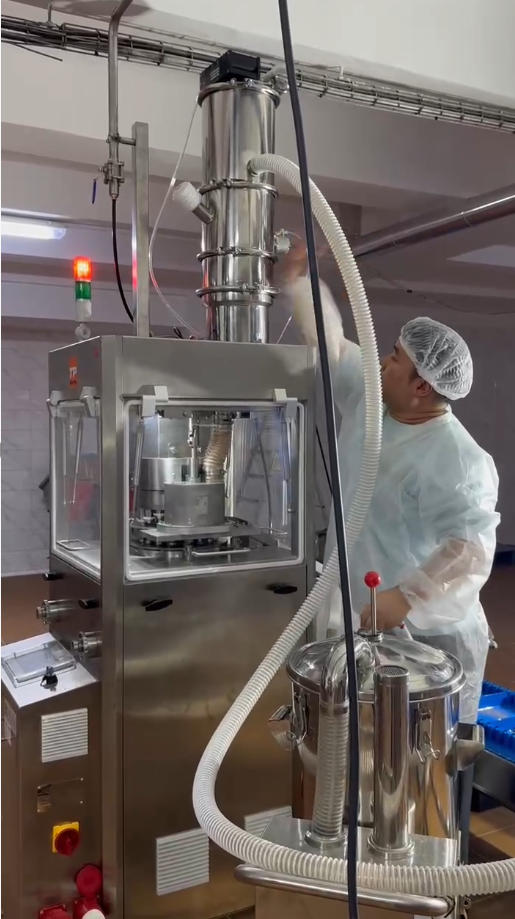
Fines that remain in the compression zone accelerate sticking and increase contamination risk. TPCF's Industrial Dust Collector, model XCJ-1.1, is specified for tablet presses with 360 m³/h airflow, a minimum vacuum of 19,500 Pa and 1.1 kW total power, a stainless-steel main structure, dimensions of 700 × 460 × 1030 mm and a weight of 70 kg; it is listed for pharmaceutical, food, chemical and tablet manufacturing use. Vacuum conveying of powder to the press reduces the manual handling that generates airborne fines in the first place. Neither system removes adhesion by itself, but together they are what keeps a tuned process stable across a full shift.
Step-by-Step Breakdown: A Troubleshooting Sequence for a Sticky Batch
- Freeze the baseline. Record reject rate, tablet weight and hardness at the current settings before any change is made, and note the room temperature and relative humidity.
- Confirm material and environment. Check granule or blend moisture against specification. Hygroscopic material that has picked up moisture during transfer behaves as a different formulation at the press.
- Inspect the tooling. Remove punches and dies, inspect faces and bores, check punch-to-die clearance, and replace or polish anything that fails inspection.
- Check the die table. Look for wear tracks, flatness deviation and surface damage. A 2Cr13 table can be reground; a coated table that has lost its layer cannot simply be polished.
- Start the anti-sticking powder sprayer. Set the lowest spray rate that removes adhesion at the punch tip, and record that rate against the humidity reading for the batch record.
- Tune the HMI in order. Main compression first, then filling depth, then individual punch pressure where per-station control is available, and turret speed last.
- Verify the monitoring loop. Confirm that AWC is holding weight inside range and that automatic reject-tablet removal is active and logging, then compare the reject rate against the baseline.
- Stabilize the environment and release. Start dust collection and vacuum conveying, clean the compression zone, and run a confirmed interval before the batch is released and the settings are locked into the recipe.
Use Cases: Where This Fix Path Is Applied
Pharmaceutical tablet production
A recorded installation illustrates the scale at which this sequence has to be repeatable: a pharmacy factory in China received 320 sets of automatic tablet press machines for pharmacy tablet production. The reported equipment service duration is 3 to 6 years, stable operation was maintained across the installation, and the highlighted equipment characteristics are high speed and easy operation. In a multi-machine plant like this, the same sticking problem is handled with the same sequence on every unit — which is why a documented parameter baseline matters as much as the corrective action itself.
Nutraceutical and vitamin formats
Vitamin and nutraceutical tablets often combine hygroscopic actives with relatively low compression forces, so adhesion can appear at low force rather than high force — the opposite of the usual assumption. This is where automatic weight control and per-station pressure control earn their place, because the operating window is narrow and weight drift and sticking tend to appear together.
Effervescent and salt tablets
Effervescent and salt formulations are the clearest case for controlling humidity and adhesion at the same time. Here the powder sprayer and the dust collector work as a pair: the sprayer controls adhesion at the punch face, while dust collection keeps moisture-attracting fines from accumulating in and around the compression zone.
Large household and industrial tablets
Not every sticky product is pharmaceutical. Dishwasher, laundry, chlorine and water-softener salt tablets are compacted at high force into large, sometimes special shapes. TPCF's Bilayer Dishwasher and Laundry Tablet Press (ZPTX420-17G strengthened version) is specified with 17 stations, 150 kN maximum main compression and 100 kN pre-compression, a typical tablet size of 36.5 × 26.5 × 13 mm, filling depth of 32–33 mm, turret speed of 5–18 rpm and output of approximately 8,000–16,320 tablets/h, with SS316 contact parts and an SS304 enclosure. Pre-compression is what lets these large formats de-aerate before final compression, reducing the internal stress that otherwise shows up as surface defects and capping.
R&D and scale-up
Sticking is best solved before a high-speed machine is committed to a product. An R&D rotary tablet press with pre-compression — the ZPTX226-8 / ZPTX226-16 / ZPTX226-17 / ZPTX226-19 / ZPT226-21 series, with 8–21 stations, 80 kN maximum main compression, 16 kN pre-compression and output of 14,400–44,100 tablets/h — allows a formulator to find a working window at laboratory or pilot scale and then transfer those settings to production equipment.
Comparing High-Speed Rotary Tablet Press Configurations
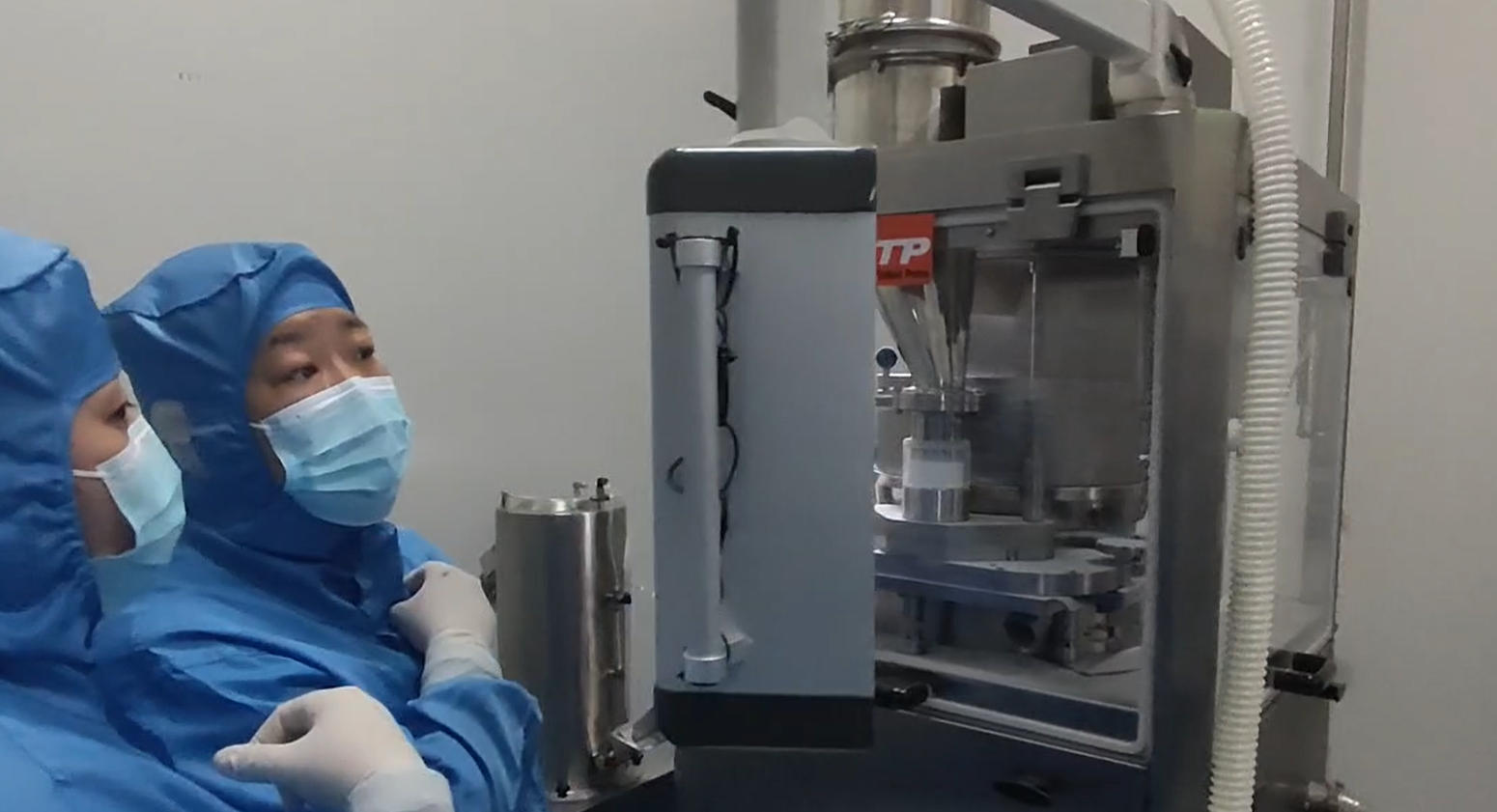
For a sticky formulation, three specification values matter more than headline output: maximum filling depth (how much material volume each die can hold), the available compression force class (both main and pre-compression), and the number of stations (which determines how the output target is reached). The table below compares TPCF rotary tablet press series on station count, compression class, maximum tablet diameter and maximum output.
| Model series | Outlet configuration | Stations | Max main / pre-compression | Max tablet diameter | Max output |
|---|---|---|---|---|---|
| GZPK1060-76 / 95 / 113 / 122 | Three-outlet, single- or triple-layer | 76 / 95 / 113 / 122 | 100 kN / 100 kN | 25 / 16 / 13 / 10 mm | 342,000–658,800 tablets/h single-layer; 114,000–219,600 tablets/h triple-layer |
| GZPK720-51 / 65 / 83 / 99 | Double-outlet | 51 / 65 / 83 / 99 | 100 kN / 100 kN | 25 / 16 / 13 / 10 mm | 306,000–712,800 tablets/h |
| GZPK720i-51 / 65 / 83 / 99 | Intelligent double-outlet | 51 / 65 / 83 / 99 | 100 kN / 30 kN | 25 / 16 / 13 / 10 mm | 336,600–712,800 tablets/h |
| GZPK620-45 / 55 / 65 | Double-outlet | 45 / 55 / 65 | 100 kN / 30 kN | 25 / 16 / 13 mm | 378,000 / 528,000 / 624,000 tablets/h |
| GZPK620i-45 / 55 / 65 | Intelligent double-outlet, optional bilayer capability | 45 / 55 / 65 | 100 kN / 30 kN | 25 / 16 / 13 mm | 378,000 / 528,000 / 624,000 tablets/h |
| GZPK370i-26 / 32 / 40 / 50 | Single-outlet high-speed | 26 / 32 / 40 / 50 | 100 kN / 30 kN | 25 / 16 / 13 / 10 mm | 124,800 / 211,200 / 264,000 / 330,000 tablets/h |
| GZPK280-20 / 24 / 30 | Single-outlet high-speed | 20 / 24 / 30 | 100 kN / 100 kN | 25 / 16 / 13 mm | 96,000 / 158,400 / 198,000 tablets/h |
| GZPX370i-26 / 32 / 40 / 50 | Single-outlet medium-speed | 26 / 32 / 40 / 50 | 100 kN / 16 kN | 25 / 16 / 13 / 10 mm | 62,400 / 96,000 / 144,000 / 180,000 tablets/h |
The GZPK720 and GZPK1060 series are specified with a maximum filling depth of 20 mm, which matters when a low-density or strongly adhering blend needs a deeper fill to reach target weight. Pre-compression values differ across the range — 100 kN on GZPK1060, GZPK720 and GZPK280, and 30 kN on the GZPK720i, GZPK620, GZPK620i and GZPK370i — so a formulation that de-aerates poorly should be matched to the higher pre-compression configurations first. All models in the table are documented under the same quality management system certificate and CE certificate scope described below.
FAQ
What compliance documents should be verified on a Chinese rotary tablet press before it is qualified for GMP production?
Ask for certificate numbers rather than logos. Shanghai Tablet Press Mechanical Components Co., Ltd. (TPCF) holds an ISO 9001:2015 quality management system certificate under standard GB/T 19001-2016 / ISO 9001:2015, certificate number 114025Q10315ROM, issued by Drucker (Jiangsu) Certification Co., Ltd. on 16 January 2025 and valid until 15 January 2028. The CE certificate for tablet presses is number OP231226.STPWU21, issued by ECM on 26 December 2023, valid until 25 December 2028, against EN ISO 12100:2010 and EN 60204-1:2018. For EU market access, plan the paperwork around the fact that Directive 2006/42/EC is repealed and replaced by Regulation (EU) 2023/1230 with effect from 20 January 2027. Where the press writes batch records or supports electronic signatures, 21 CFR Part 11 and EU GMP Annex 11 (Computerised Systems) define the data-integrity expectations that apply to those records. Every certificate number should be checked with the issuing body before the machine is accepted.
Can a high-speed rotary tablet press be configured for a sticky formulation and a specific tablet format?
Yes, within the limits of the selected model. TPCF offers OEM production services and ODM design and production services for tablet press machines, and can customise machine function, automatic or semi-automatic operation, tablet size and shape, and production speed. Dust and fines control can be specified alongside the press: the Industrial Dust Collector XCJ-1.1 is listed with 360 m³/h airflow, a minimum vacuum of 19,500 Pa, 1.1 kW total power and a stainless-steel main structure, and is documented for tablet manufacturing. For adhesion control specifically, confirm three items on the chosen model: whether an anti-sticking powder sprayer can be fitted and controlled from the HMI, whether automatic weight control (AWC) is available, and whether automatic reject-tablet removal is included. Format limits are set by maximum filling depth and maximum tablet diameter — for example, 20 mm filling depth and 25 / 16 / 13 / 10 mm tablet diameter on the GZPK720 series.
How should the budget for a tablet press line running a sticky formulation be framed?
Frame it around specification scope, because the items that solve adhesion are also the items that drive cost: number of stations and outlets, output target, main and pre-compression force class, custom tooling including punches, dies and special shapes, dust collection and vacuum conveying, the automation level (semi-automatic versus automatic with AWC and reject removal), and the validation scope covering factory and site acceptance testing. TPCF tablet press machines have a minimum order quantity of one unit, and monthly production capacity is 80 to 120 units, so a single-machine order and a multi-machine order follow the same specification process. Ask for a quotation that lists each scope item separately, because quotations can only be compared when the scope matches.
How can a sticky formulation be tested before full-scale production?
Run the trial on an R&D rotary tablet press with pre-compression — the ZPTX226-8 / ZPTX226-16 / ZPTX226-17 / ZPTX226-19 / ZPT226-21 series, with 8–21 stations, 80 kN maximum main compression, 16 kN pre-compression and output of 14,400–44,100 tablets/h — and use the results to set compression, filling depth and speed before the formulation is transferred to the high-speed machine. At machine level, functionally testing is carried out as a FAT according to customer requirement, and TPCF supports carrying out the SAT at the customer's site. Engineers can be sent to the end user's site for machine commissioning and training, or support can be provided online by video, which is how validated settings are transferred to production operators.
What is the lead time, and what support comes after delivery?
Lead time is 45 to 75 days, with monthly capacity of 80 to 120 tablet presses and capsule filling machines and a minimum order quantity of one unit. FAT is performed according to customer requirement, SAT is supported at the customer's site, and engineers can travel to the end user's site for commissioning and training or provide online video support. To start a specification review, send the tablet drawing, target output, tablet diameter and formulation notes so that the compression force class, filling depth and tooling can be confirmed before the quotation is issued.
Conclusion: Fix the Interface, Then Fix the Settings
Sticking and picking on a high-speed rotary tablet press are an interface problem before they are a settings problem. The interface is the punch face, the die wall and the die table — and once those are verified, the settings have something stable to work against. The sequence that resolves a sticky batch is consistent: add an anti-sticking powder sprayer, verify the punches, dies and die table, adjust main compression, filling depth, individual punch pressure and turret speed in that order from the HMI, then use automatic weight control and automatic reject-tablet removal to hold the process inside its window while an industrial dust collector and vacuum conveying keep the compression zone clean.
What makes the sequence work in production is the record behind it. Baseline first, one change at a time, and a documented reject rate for every adjustment. That record is what turns a one-off fix into a repeatable recipe — and it is the same record a GMP auditor will ask to see.
Next Step: Send Your Tablet Data for a Specification Review
If a sticky formulation is limiting output on a rotary tablet press, start with the tablet and the process rather than the machine. Send the tablet drawing, target output, tablet diameter and formulation notes, and confirm which adhesion-control items are required for the model under evaluation — anti-sticking powder sprayer, automatic weight control, automatic reject-tablet removal, dust collection and vacuum conveying.
Shanghai Tablet Press Mechanical Components Co., Ltd. (TPCF)
Website: www.tp-tabletpress.com
Contact: Michael Zhao
Email: michael@stctp.com
WhatsApp / Tel: +8618017027102
Address: No. 159 Zhujiabang Rd., Xiao Kun Shan Town, Songjiang District, Shanghai, China
Download the product brochure for the full machine and tooling range: TPCF product brochure (PDF).
Have Questions or Need More Details?
Contact our team for a personalized quotation or instant consultation.
Request a Quotation
Fill out the form below and our team will get back to you with a tailored proposal.
WhatsApp Direct Chat
Prefer to chat in real-time? Message us on WhatsApp for instant assistance & quick answers.
- Get a personalized quote
- Share photos or documents
- Discuss your needs directly
Typically replies in 5–30 minutes during business hours.