
Tablet Press GMP Certification: What Buyers Must Verify
A GMP-compliant tablet press that survives an audit rests on three things: a current ISO 9001:2015 certificate whose scope covers your exact machine category, a CE certificate that names the models you are buying, and validation documentation that supports IQ/OQ/PQ at the end user's site. If any one of those three is missing, you do not have a compliance problem on paper — you have a compliance problem waiting to surface during qualification.
Most of the evaluation-stage work on a tablet press purchase is not spent deciding whether to buy the machine. It is spent verifying certificate numbers, checking whether the range covers the unit on the quotation, and confirming that the contact-part materials meet the standard your quality team will audit against.
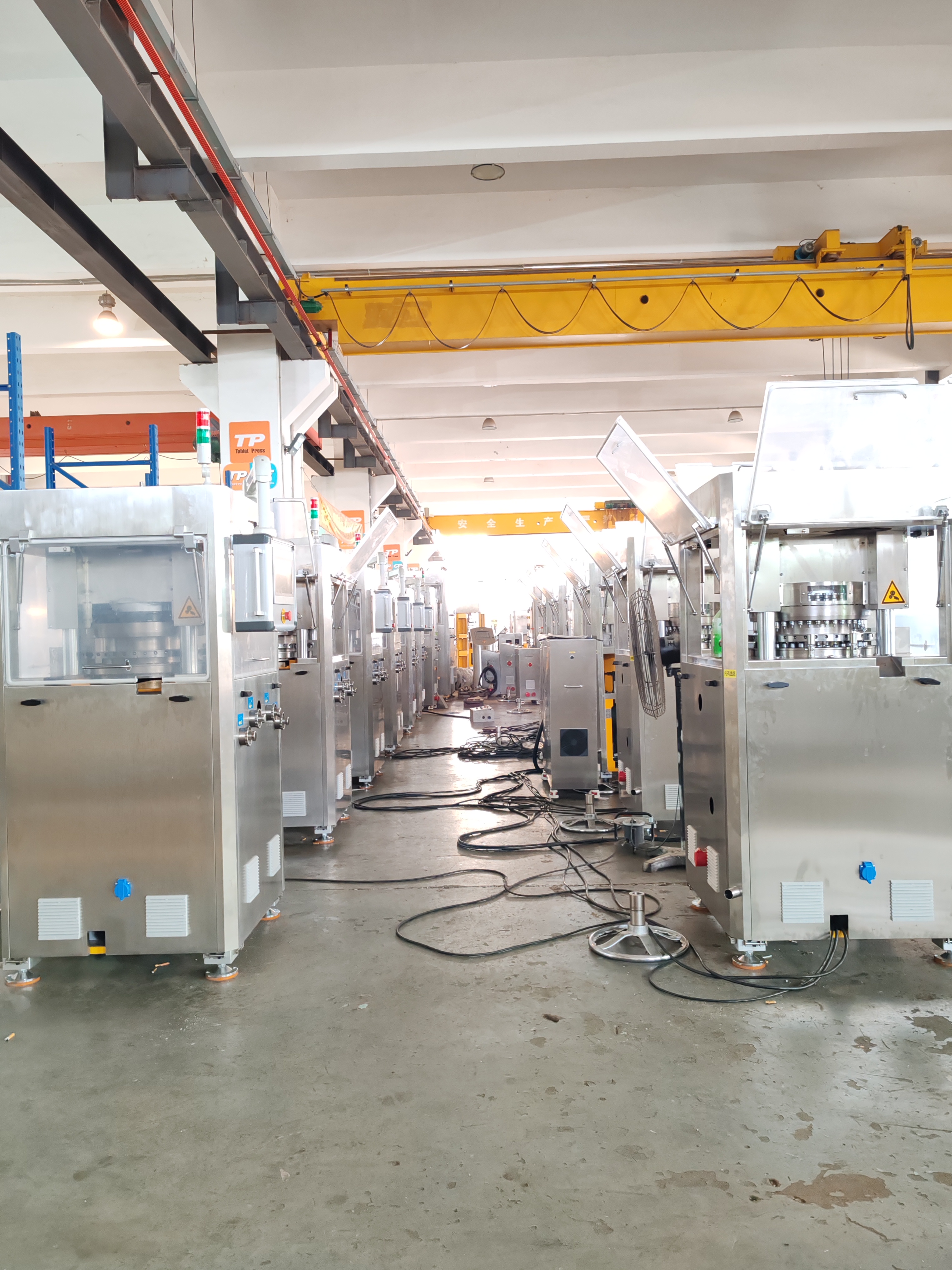
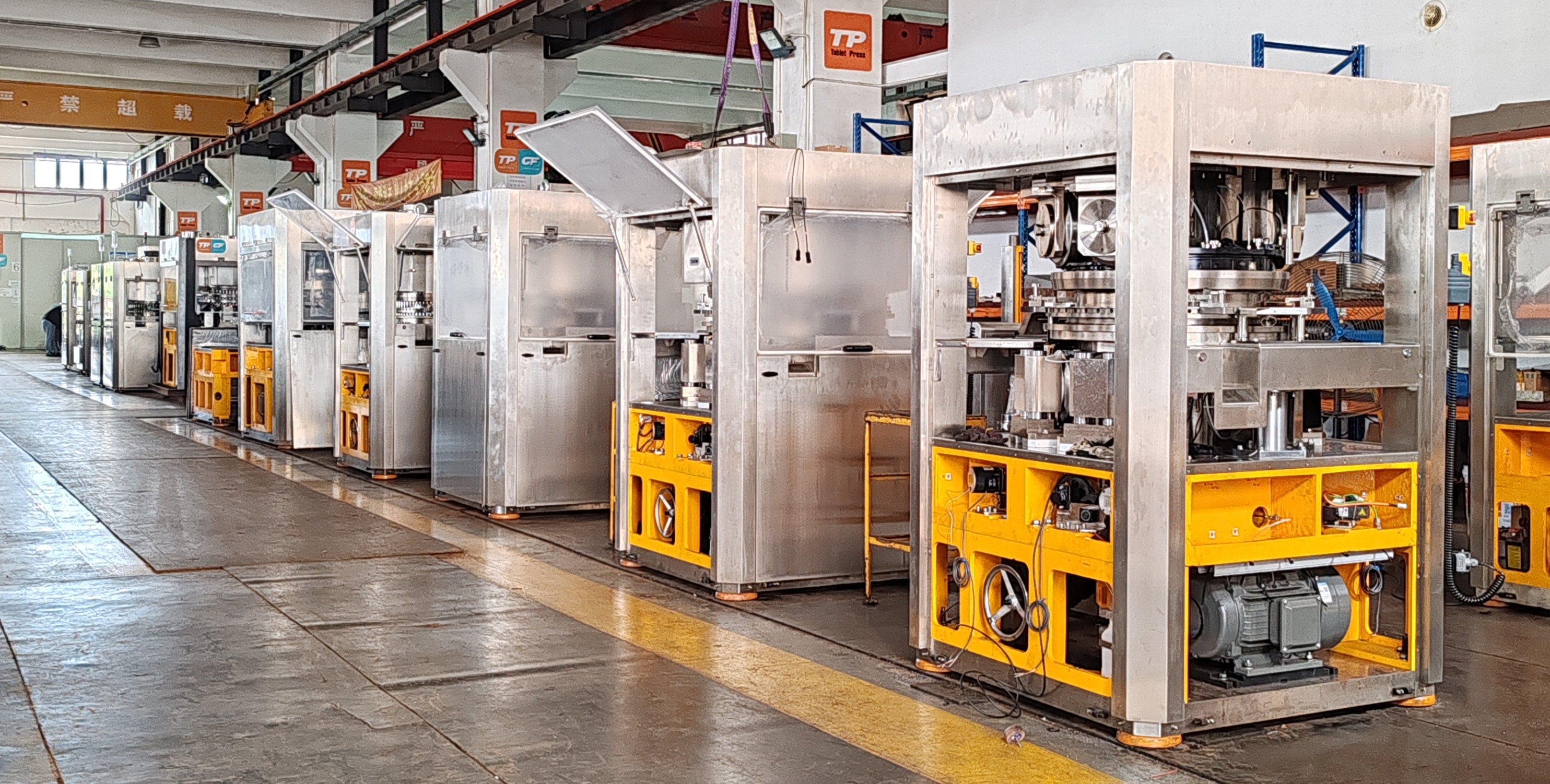
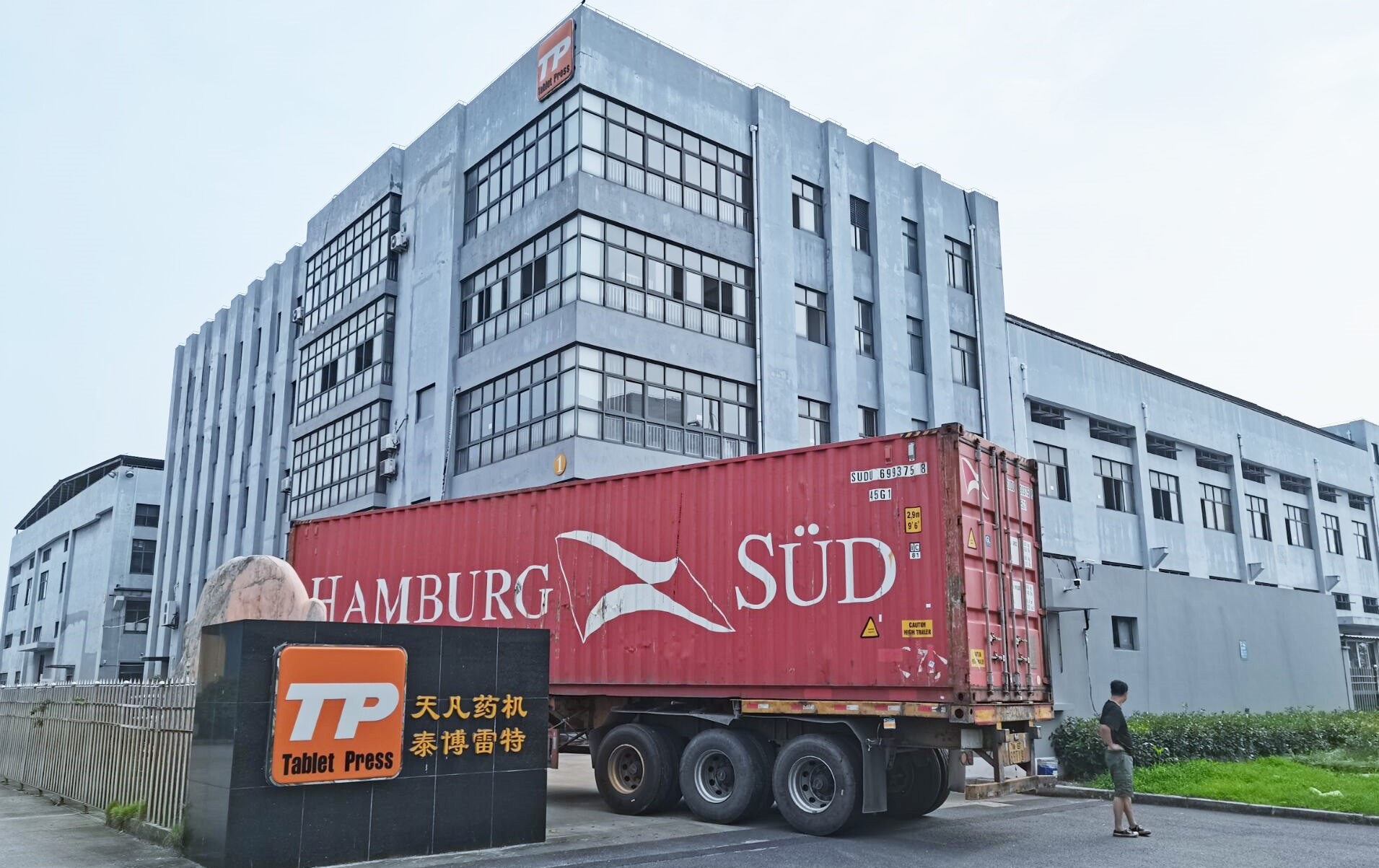
This guide walks through what a buyer in a regulated industry actually has to confirm when a supplier calls a machine "GMP compliant." The concrete examples come from Shanghai Tablet Press Mechanical Components Co., Ltd. (TPCF), a tablet press manufacturer operating a 15,000 m² factory in Shanghai that exports to Asia, South Africa, the Middle East, the EU, Russia, and North and West Africa. The point is to treat compliance as a procurement variable, not a brochure checkbox.
What "GMP Compliant" Actually Means for a Tablet Press
GMP compliance is not a single label applied to a machine. It is a set of requirements that a buyer has to verify against the specific unit being purchased.
For a tablet press, GMP expectations fall into three layers:
- Machine design — hygienic construction, stainless steel contact parts, no inaccessible dead zones, easy disassembly for cleaning, dust containment.
- Supplier quality system — an ISO 9001:2015 certificate that covers the manufacturing scope of the machine, not a generic company-level certificate.
- Documentation — validation support files, material certificates, calibration records, and certificate originals. This is the layer that fails most often in regulated plants.
When a supplier says a machine is "GMP compliant," they usually mean layer one. Layer three is what protects the buyer.
Why Buyers Get This Wrong
The most expensive mistakes in this category are predictable:
- Accepting a company-level ISO certificate as if it covered the specific model being purchased.
- Accepting a CE certificate that was issued for a different machine configuration.
- Assuming a CE mark satisfies Chinese GMP requirements — they are different frameworks.
- Not writing IQ/OQ/PQ support into the purchase order, leaving no paper trail at handover.
- Not confirming that the supplier can support FAT and SAT when the audit team asks.
None of these are complex issues. All of them are cheaper to resolve during the quotation stage than after the machine has arrived at the plant.
The Regulatory Landscape That Is Shifting Now
On 20 January 2027, Regulation (EU) 2023/1230 replaces Directive 2006/42/EC as the legal basis for EU machinery compliance. Machines placed on the EU market after that date are assessed against the new regulation. A tablet press that only holds CE conformity issued under the outgoing directive may need to be re-evaluated if it is commissioned into an EU facility after the transition.
This matters more than it sounds. If a machine ships in 2026 and runs for ten years in an EU plant, the compliance file needs to hold up beyond the transition date.
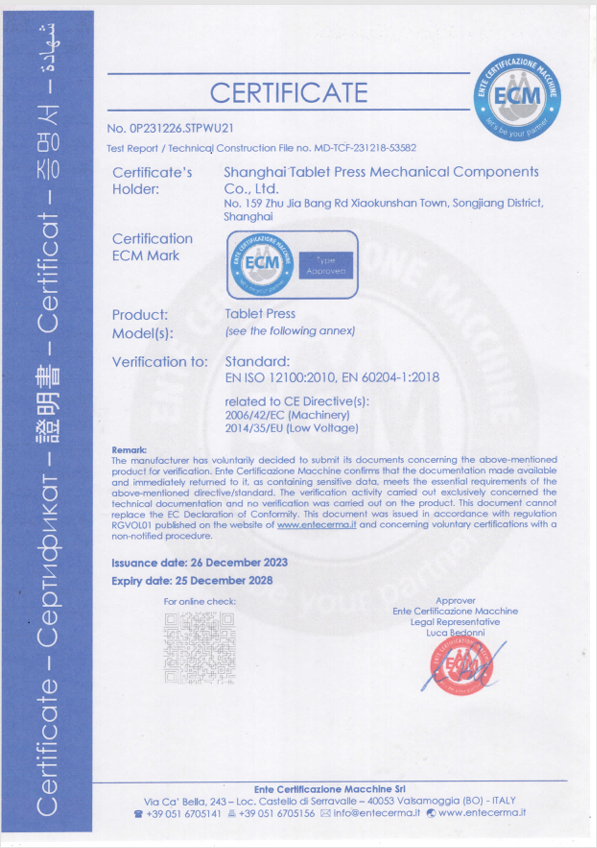
TPCF's CE certificate OP231226.STPWU21, issued by ECM against EN ISO 12100:2010 and EN 60204-1:2018, is valid until 25 December 2028. That window covers the 2027 regulation transition, which is exactly the kind of detail a buyer should look for on the certificate itself.
In the United States, 21 CFR Part 11 governs electronic records and electronic signatures in FDA-regulated processes. In the EU, GMP Annex 11 (Computerised Systems) applies a risk-based approach to the same topic. Both bear directly on how a tablet press reports batch data, stores alarm logs, and controls user access. Machines without these capabilities cannot be retrofitted cleanly later.
What to Verify on a GMP Tablet Press
The list below is what belongs in a request for quotation, not a post-purchase checklist.
1. ISO 9001:2015 certificate, with scope
Ask for the certificate number, issuing body, scope statement, and expiry date. The scope has to cover the machine category you are buying. If the scope says something like "mechanical components" or just "tablet presses," press further to see which models are actually covered.
TPCF holds ISO 9001:2015 certificate 114025Q10315ROM, issued by Drucker (Jiangsu) Certification Co., Ltd. against GB/T 19001-2016 / ISO 9001:2015, valid from 16 January 2025 to 15 January 2028. The scope covers high-speed rotary tablet presses and rotary tablet presses. That is the level of detail a buyer should read literally, not skim.
2. CE certificate with a model list
A CE certificate should list the certified model designations. A certificate that says "tablet press" without a model list is not a certificate you can rely on.
TPCF's ECM CE certificate names models including the GZPK1060 series high-speed rotary tablet press, the GZPK720 double-outlet high-speed tablet press, the GZPK720i intelligent double-outlet high-speed tablet press, the GZPK620i series with optional bilayer capability, the GZPK370i single-outlet high-speed tablet press, the GZPX370i single-outlet medium-speed tablet press, and the GZPK280 series single-outlet high-speed tablet press. Additional coverage pages list the ZPTX226, ZPTX340, ZPTX420, ZPT420, ZPTY550, GZP550i, and GZP550 models.
3. Contact-part material specification
This is the parameter buyers most often regret not specifying earlier. Two details matter:
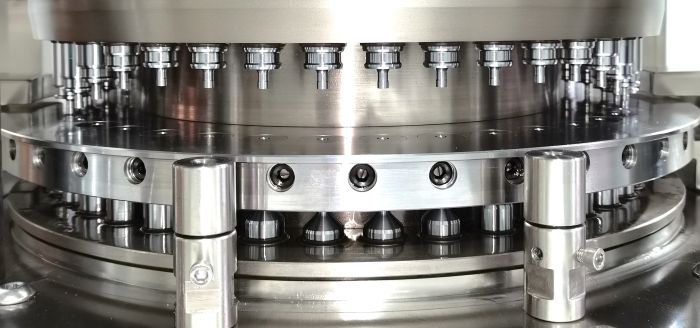
- Die table material. A traditional cast-iron die table with a nickel coating carries a specific risk — once the nickel layer is scratched or worn through, the underlying iron is exposed and can contaminate the product stream. TPCF uses one-piece 2Cr13 stainless steel die tables on multiple models, with no nickel plating required. That is a genuine compliance advantage, not marketing language.
- Contact-part materials. On bilayer machines such as the ZPTX420-17G, TPCF specifies SS316 for force-feeder walls, impellers, hopper, and other major product-contact parts, with an SS304 enclosure. SS316 is more corrosion-resistant and easier to clean than SS304 in the wetted path.
4. Acceptance test scope
Write FAT and SAT into the purchase order. TPCF performs FAT testing according to customer requirements and helps the customer carry out SAT at the end user's site. That arrangement is directly useful to a procurement team because it gives acceptance a paper basis.
5. Data integrity capability
If the end market is the US or the EU, specify audit trail, electronic data export, and access control requirements up front. Many machine suppliers display parameters on an HMI but do not meet Part 11 or Annex 11 expectations for data integrity. This has to be settled during quotation, not at commissioning.
Step-by-Step Procurement Flow
- Fix the applicable regulation first. China GMP, EU GMP Annex 11, and 21 CFR Part 11 place different demands on the machine. Decide which frameworks apply before specifications are drafted.
- Request original certificate files. Ask for PDFs, not screenshots. Check the certificate number, issuing body, standard reference, expiry date, and model coverage.
- Match model coverage against the quotation. Once you have a quotation, cross-check it against the certificate model list. If a model is missing, ask the supplier to update the certificate or change the quoted configuration.
- Lock in material specifications. Put contact-part material grades in the purchase order. SS316 and SS304 differ in both compliance profile and unit cost.
- Define the test scope. Specify who runs FAT and SAT, against what criteria, and what documents come out of each stage.
- Confirm spare parts and after-sales support. TPCF can send engineers to the end user's site for commissioning and training, or support customers online by video. For first-time buyers, this is often under-weighted.
- Plan for the regulatory transition. If the machine is EU-bound, plan around the 20 January 2027 date and confirm the supplier's CE certificate spans that window.
Where These Requirements Hit Real Buyers
Pharmaceutical plant exporting to the EU
A pharmaceutical manufacturer selling into the EU needs CE conformity, current machinery directive or regulation coverage, and a control system that satisfies Annex 11 for computerised systems. A CE certificate valid through December 2028, spanning the 2027 regulation transition, becomes a hard selection criterion rather than a nice-to-have.
Domestic pharmaceutical plant in China
A domestic plant needs the machine to align with China GMP (2010 revision) and needs a live ISO 9001 certificate covering the specific models it operates. One-piece 2Cr13 die tables and SS316 contact parts are the kinds of details an auditor will inspect during a site visit.
R&D and pilot-scale workshop
R&D operations care about formulation flexibility, small-batch capability, and cleaning access between trials. TPCF's ZPTX226 R&D rotary tablet press offers 8 to 21 stations, 80 kN maximum main compression, and 16 kN pre-compression — usable for pilot scale, and configured for frequent tooling changes and cleaning.
Non-pharmaceutical tablet production
For dishwasher tablets, laundry tablets, chlorine tablets, and water-softener salt tablets, the compliance emphasis shifts to corrosion resistance of contact parts, dust control, and bilayer compression capability. TPCF's ZPTX420-17G strengthened model was developed for exactly this class of large, high-compression tablets.
Compliance Framework Comparison
| Framework | Jurisdiction | Applies To | Key Buyer Action |
|---|---|---|---|
| China GMP (2010 revision) | China | Domestic pharmaceutical production | Confirm machine design and supplier documentation against GMP practice |
| EU GMP Annex 11 (Computerised Systems) | European Union | Computerised systems used in GMP manufacture | Specify risk-based validation for automated control systems |
| 21 CFR Part 11 | United States | Electronic records and signatures in FDA-regulated processes | Confirm audit-trail and electronic-signature capability |
| ISO 9001:2015 | International | Supplier quality management system | Verify certificate scope matches purchased models |
| Regulation (EU) 2023/1230 | European Union | Machinery market access from 20 January 2027 | Confirm certificate coverage extends past the applicability date |
| Directive 2006/42/EC | European Union | Current CE marking framework for machinery | Verify the certificate is in force for the delivery date |
Frequently Asked Questions
What is the difference between a China GMP-compliant tablet press and a CE-marked tablet press?
They cover different regulatory territories. China GMP (2010 revision) governs pharmaceutical production inside China. CE marking is the market-access requirement for machinery placed on the EU market. A CE-marked machine does not automatically satisfy China GMP documentation expectations, and vice versa. If the product portfolio serves both markets, the two sets of requirements should be specified separately in the purchase order.
Which validation documents should come with a GMP tablet press?
At minimum: an ISO 9001:2015 certificate covering the purchased model category, a CE certificate for EU-bound machines, contact-part material records, and documentation that supports IQ/OQ/PQ execution. TPCF's ISO certificate is valid until 15 January 2028 and its ECM CE certificate is valid until 25 December 2028, both spanning the current procurement cycle. These documents should be listed as deliverables in the purchase order.
What drives the cost of a GMP-compliant tablet press?
Cost drivers include machine size, number of stations, whether the configuration is single-layer, bilayer, or triple-layer, the level of data-integrity capability, and the certification scope required for the destination market. Compliance itself is rarely the main price gap between suppliers, but missing model coverage or missing data-integrity features tend to be far more expensive to retrofit than to specify up front. Detailed configuration pricing is best handled through a direct quotation rather than a published table.
Can a buyer verify compliance before placing a full order?
Yes. In most procurement flows this is done through factory testing. TPCF performs FAT tests according to customer requirements and can help the customer carry out SAT at the end user's site. For first-time buyers, the process often also includes small-batch trial compression or sample validation to confirm that the formulation and machine configuration match. Both stages produce documentation that feeds directly into qualification.
What lead time should a buyer expect for a GMP tablet press?
TPCF's standard lead time is 45 to 75 days, depending on model and configuration. The company delivers 80 to 120 tablet presses and capsule filling machines per month. Configurations involving non-standard contact-part materials, additional certification coverage, or data-integrity features may push lead time beyond that window. Buyers should write the lead time and acceptance conditions into the purchase order together. For a specific configuration and delivery estimate, the fastest path is to send the required specification and destination market to TPCF for a documented quotation.
Conclusion
For a procurement team, a GMP-compliant tablet press comes down to three things: certificate scope that actually covers the model, contact-part material specifications that will hold up to audit, and validation documentation that supports the qualification process. When those three are written into the purchase order, most of the compliance risk is controlled before the machine is built.
TPCF currently covers this requirement across a full product line, from compact R&D tablet presses through high-speed rotary machines producing more than 300,000 tablets per hour. If you need to verify original certificates before committing to a purchase, the company can provide them directly.
To review material records and validation support on a model-by-model basis, contact TPCF for a configuration list, or download the product catalog for the full model range.
TPCF — Shanghai Tablet Press Mechanical Components Co., Ltd. · www.tp-tabletpress.com · michael@stctp.com
Have Questions or Need More Details?
Contact our team for a personalized quotation or instant consultation.
Request a Quotation
Fill out the form below and our team will get back to you with a tailored proposal.
WhatsApp Direct Chat
Prefer to chat in real-time? Message us on WhatsApp for instant assistance & quick answers.
- Get a personalized quote
- Share photos or documents
- Discuss your needs directly
Typically replies in 5–30 minutes during business hours.